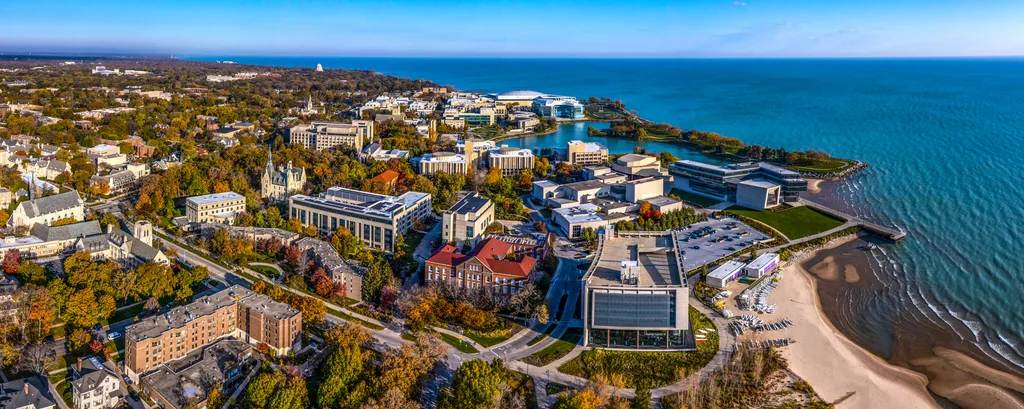
Evanston, IL Solar Panels
In This Guide

Solar Power in Evanston
Planning solar panel installation in Evanston, IL? Northern Illinois winters and shade from mature neighborhood trees can affect how much sunlight a roof receives, so evaluating roof direction, shade, and household electricity use is an important first step.
Explore what local homeowners should know, from how home solar panels work to the practical steps involved in installing a system.
How Much Do Solar Panels Cost in Evanston, IL?
Explore solar installation costs in Evanston with an estimate informed by real installation data from the area. Palmetto’s calculator uses local experience, including projects in nearby Skokie, Wilmette, Lincolnwood, and Morton Grove, to help you understand what a solar system may cost for your home.
System
- No upfront investment
- Palmetto handles all maintenance
- 90% Production Guarantee
- Comprehensive protection program included
Key Takeaways
- Roof shade and direction matter in Evanston; mature trees, winter weather, and shorter days affect solar output, though systems can still produce useful energy year-round.
- Solar costs and savings are estimates, not guarantees: a sample 9.84-kW system costs $28,095, with estimated 25-year savings of $60,811.
- Illinois incentives have different eligibility rules; Illinois Shines, Solar for All, and ComEd rebates may help qualifying projects, so check current terms and contracts.
Evanston Electricity Prices
Electricity prices can shape the long-term cost of powering an Evanston home.
Illinois residential electricity averaged 13.2¢ per kWh in 2021 and 15.9¢ in 2024. Rates reached 15.7¢ in 2022 and stayed there in 2023, while the U.S. average climbed from 13.7¢ to 16.5¢.
Solar panels can let an Evanston household generate some electricity at home, potentially reducing the amount purchased from the utility. The amount offset depends on system production, household use, and utility billing rules.
Over time, producing some power at home may help limit exposure to changing electricity rates and add predictability to energy costs. Actual value depends on installation costs, upkeep, system performance, and how rates change.
Price of Energy: Illinois vs National Average
Evanston Area Utility Providers
In Evanston, ComEd is the listed electricity utility. The latest figures available here are from 2023: ComEd’s average rate was 14.8¢ per kilowatt-hour (kWh).
That was below Illinois’ 2023 average of 15.70¢/kWh and the national average of 16.0¢/kWh. These figures show the difference, but do not explain what caused it.
For Evanston households, rooftop solar can provide some electricity where conditions allow, potentially reducing reliance on grid power. The amount varies with system output and household use; these rate comparisons alone cannot predict savings.
Evanston Utilities Electricity Rates
Illinois Solar Incentives
Evanston homeowners may find state and utility incentives that help offset eligible solar installation costs. Explore solar incentives in Illinois below.
Illinois Shines may provide renewable energy credit contract value, while Illinois Solar for All offers eligible households and certain organizations qualifying solar or community solar with reduced or no upfront costs and bill-savings protections.
Eligible ComEd and Ameren customers may qualify for solar-generation and battery rebates, subject to program rules. Illinois also has an alternate property-tax valuation process for eligible solar improvements; it is not an automatic exemption.
| Incentive | Type | Description | Source |
|---|---|---|---|
| Illinois Shines (Adjustable Block Program) | Solar renewable energy credit (REC) incentive | Qualifying Illinois rooftop-solar and community-solar projects can earn REC-contract value, which may reduce a customer’s project cost or be passed through according to the customer’s contract. | Learn More |
| Illinois Solar for All (ILSFA) | Income-qualified solar incentive | Eligible households and certain nonprofits and public facilities can access qualifying solar or community solar with reduced or no upfront costs and required bill-savings protections. | Learn More |
| ComEd Distributed Generation Rebate | Utility solar rebate | Eligible ComEd residential and small-load customers may receive a rebate of $300 per kW for qualifying customer-owned renewable generation equipment. | Learn More |
| ComEd Residential Battery Storage Rebate | Utility battery storage rebate | Eligible ComEd residential customers may receive $300 per kWh of qualifying battery storage capacity, subject to utility program and tariff requirements. | Learn More |
| Illinois Solar Energy System Property-Tax Valuation | Property-tax valuation provision | Eligible Illinois solar-energy-system improvements may use an alternate property-tax valuation process, which can limit how the system’s value is reflected in an assessment but is not an automatic tax exemption. | Learn More |
Illinois Shines supports qualifying on-site solar and community-solar projects by contracting for the renewable energy credits (RECs) the systems are expected to produce. For 2026–27, the published REC prices for small distributed-generation projects up to 10 kW AC are $70.37 per REC in Group A and $80.77 per REC in Group B; eligible customer-owned small systems that do not receive a federal clean-energy credit may qualify for an additional $20 per REC. A REC represents 1 MWh of generation, so the total value depends on estimated production, location, project category, and program rules—not simply system size.
The REC payment is made to the Approved Vendor, not automatically as a household rebate. The customer’s purchase, lease, or power-purchase agreement determines whether and how much value reaches the customer; review the Illinois Shines disclosure and contract before signing. Capacity and waitlist status can change, and qualifying small-system contracts approved on or after June 1, 2026 pay 50% at energization with the remainder paid over the following six years.
Illinois Solar for All uses REC contracts with approved project vendors to make solar more affordable for eligible participants. For qualifying residential rooftop projects, the program is structured to offer no upfront cost for many 1–4-unit homes, while other eligible properties may receive low- or no-upfront-cost offers; community-solar subscriptions are also available. The customer benefit is the project pricing and required savings protections, not a standard cash payment to every household.
Residential and community-solar household eligibility is generally based on gross income at or below 80% of Area Median Income, adjusted for household size and location. Program requirements, including savings, maintenance, and warranty protections, apply, and funding and application windows are limited. Confirm current eligibility and availability through the program before relying on an offer.
ComEd’s published rebate materials list a $300-per-kW rebate for qualifying residential and small-load customer-owned renewable generation. The rebate can lower the net upfront cost of an eligible solar installation, but the amount is based on qualifying system capacity and program rules; it is not a universal payment for every solar system.
Equipment, smart-inverter, interconnection, customer-class, and tariff requirements apply. If you are on legacy full-retail net metering, taking a generation rebate may affect your delivery-service credits or legacy billing status under the applicable utility rules. Confirm the current rebate terms and the effect on your specific net-metering arrangement with ComEd in writing before applying.
ComEd’s published program materials list a storage rebate of $300 per kWh for eligible residential and small-load customers. The rebate can reduce the cost of a qualifying battery, with the payment determined by eligible storage capacity and the program’s terms. ComEd’s materials specify hourly supply service (BESH) for the residential storage rebate.
Eligible equipment, smart-inverter, customer-class, and tariff requirements apply; verify whether the battery must be paired with or charged by an on-site renewable generator under the current terms. Storage receiving a rebate on or after June 1, 2026 may also be subject to scheduled-dispatch requirements, with ComEd’s filed rider indicating service may begin no later than March 1, 2027. Confirm the obligation and any compensation with ComEd before applying.
Illinois law provides an alternate valuation process for eligible solar-energy-system improvements. A property owner may file a claim with the county chief assessment officer; depending on the system, property, and applicable assessment rules, the process can affect the assessed value used to calculate property taxes and may reduce the tax impact compared with ordinary valuation.
This is not a blanket exemption from property taxes and does not guarantee a particular dollar savings. Eligibility and the valuation calculation depend on the property and system, and the owner must follow the applicable filing process. Contact the county assessor and review the Illinois Department of Revenue guidance to determine whether your installation qualifies.
Ready to start saving with solar?
Speak with a Palmetto solar expert to find out exactly how much you can save with Illinois incentives.
Get a Free QuoteEvanston Solar Irradiance
Solar panel production varies throughout the year based on daylight hours, weather patterns, and sun intensity. Understanding how seasons affect your solar system helps set realistic expectations for your investment.
Evanston’s shorter winter days, snow, clouds, and Lake Michigan weather can affect monthly solar output, while long summer daylight helps. A well-designed system can still produce useful energy year-round.
Solar Production in Evanston by Month
What Can Your Solar System Power?
Summer Production (July)
In July, your 10 kW system could power:
- 3.6 average homes (15 kWh/day per home)
- or Run central AC for 18 hours AND power all other appliances
- or Fully charge 5.4 Tesla Model 3 electric vehicles
Winter Production (December)
In December, your 10 kW system could power:
- 2 average homes (15 kWh/day per home)
- or Keep your home heating system running for 15 hours
- or Fully charge 3 Tesla Model 3 electric vehicles
Annual Production
Over a year, your 10 kW system could:
- Offset 10 tons of carbon dioxide emissions
- or Equal the environmental benefit of planting 175 trees
- or Save approximately $4,234 in electricity costs
Want to know exactly how much solar can power your home?
Get a personalized solar analysis based on your actual home, energy usage, and roof characteristics.
Get My Custom EstimateSolar Panel Systems in Evanston
We’ve organized solar installation data from across the United States into this interactive map of Evanston. Explore the hexagons to see installation counts and discover how neighbors across Evanston’s neighborhoods and nearby communities have made the switch to solar.
How to Choose a Solar Installer in Evanston
Verify the license
Illinois does not have a general state contractor license for solar installers. Instead, Illinois Commerce Commission (ICC) certification is required before covered distributed-generation installation work—generally the electrical wiring and connections needed to interconnect a system with the utility distribution system. Planning or project management alone is not covered, so ask which company will perform each part of the work and who is responsible for the electrical scope. Check the responsible installer through the ICC’s distributed-generation installer page. Roofing work may separately require an IDFPR roofing-contractor license, depending on the scope.
Look for certified installers
Ask whether the people designing or installing your system hold a relevant NABCEP certification, and which team members hold it. Treat this as an additional professional credential, not a substitute for required ICC certification. Ask about manufacturer certifications, too: these may indicate training or qualification for particular products. Confirm which brands and models the certification covers and whether it affects the warranty terms offered to you. Compare the credentials and responsibilities of the actual companies and crews on your project, not just the sales representative’s.
Compare quotes the same way
Request written quotes with the same details, then compare:
- System size in kilowatts (kW) and total price; calculate price per watt on the same basis for each quote.
- Panel and inverter brands and models.
- Estimated production in kilowatt-hours per year (kWh/year), along with the assumptions behind the estimate.
- Warranty terms for panel product and performance, inverter, workmanship, and roof penetrations.
- Who handles plan review, permits, inspections, and the utility interconnection request.
- Total cost if purchasing, or monthly payment and any escalator if financing or leasing. Compare the full payment terms, not only the starting payment.
For context, Palmetto reports a median installed system size of 9.8 kW and about 94 days from signing to installation. Those figures are a reference point, not a promise or a substitute for comparing your project’s scope and schedule.
Permits, interconnection and your HOA
For privately funded residential work, the local unit of government handles required plan review, permits, and inspections; requirements vary by location. Ask who will coordinate them. The homeowner or installer applies to the electric distribution company (EDC) serving the property. Depending on the address, local utilities include Commonwealth Edison Co, Ameren Illinois Company, MidAmerican Energy Co, or City of Springfield – (IL); check which serves your home and who will submit the request. Illinois’ Homeowners’ Energy Policy Statement Act says an association may not prohibit or effectively prohibit a solar energy system. Design and configuration requirements are allowed within limits, including that they may not reduce estimated annual production by more than 10% (765 ILCS 165/15 and 165/20).
Red flags
- Pressure to sign the same day or before you can review the written terms.
- Unlicensed or out-of-state crews who cannot clearly identify the responsible contracting company and, where required, the ICC-certified party. Out-of-state status alone does not establish a problem.
- Vague production estimates or reluctance to provide the estimate and assumptions in writing.
- A large upfront deposit without clear written milestones and terms.
- Promises of federal tax credits for homeowner purchases made in 2026; homeowner credits ended December 31, 2025.
If you have a concern about home-improvement work, contractor conduct, or solar sales, the Illinois Attorney General’s Consumer Protection Division is the primary state contact; the ICC handles complaints about Part 468 certification or compliance.
Leasing Solar Panels
In Evanston, ComEd customers can access Palmetto’s solar Power Purchase Agreement (PPA). A lease is not listed as available for this utility; options can vary by utility and location.
With a PPA, you pay a set price per kilowatt-hour for the electricity your system produces, rather than a fixed monthly lease payment. Solar output and payments may be higher in summer. Over a year, costs can be similar to a lease, though results depend on your usage, system production, utility charges, and contract. Learn more about buying or leasing solar.
Unlike paying cash for a system, a PPA avoids the full upfront purchase and typically leaves system maintenance to its owner, subject to the contract. Review service coverage and terms, and explore LightReach.
Go solar without the investment
With LightReach, there are no investment costs to recoup, loan payments to manage, or maintenance needs to take on. As soon as your panels are active, your solar savings are too!
Explore LightReach LeasingFrequently Asked Questions
Yes. Evanston homes served by ComEd can receive credits for solar electricity sent to the grid, but the value depends on when the system received permission to operate (PTO).
Systems with PTO before January 1, 2025, generally receive full-retail net-metering credits; excess credits roll over monthly and expire in April or October. For systems with PTO on or after that date, exported power earns ComEd’s Price to Compare credit, which offsets supply and transmission charges—not delivery fees, taxes, or other bill charges. Remaining credits roll over until used.
Yes, an owned solar system may increase a home’s resale value in Evanston. Zillow found homes with solar panels sold for about 4.1% more on average. This is not a guaranteed premium; results vary by home and market.
That potential value applies to purchased systems, not leased or third-party-owned (TPO) systems. Evanston roof condition and tree shade can affect system performance. With a lease or PPA, a buyer may need to assume the agreement, which can affect resale differently.
In Evanston, homeowners can use the LightReach lease to go solar with no upfront cost and a low fixed monthly payment. The calculator estimates $79 per month for a 2,000–3,000-square-foot home; estimates range from $58 to $108 per month by home size.
A cash purchase is another option: the calculator estimates $28,095 for a typical system, with sample costs from $21,257 to $37,648. The federal 30% tax credit is no longer available for residential cash purchases following the 2025 federal law change. See the calculator above for estimates by home size.
With a solar lease, a provider owns the system and the homeowner makes monthly payments to use its electricity. A typical 9.84-kW Evanston system is estimated at $79/month, calculated using Illinois’ 1,134 kWh/kW/year production ratio and a $0.085/kWh rate.
LightReach has no upfront cost; one payment covers installation, monitoring, maintenance, and protection, including a 90% production guarantee. Savings may begin if payments are below avoided electricity costs. Palmetto lists a PPA, not a lease, for Evanston ComEd customers, so confirm available contract options.
For solar installation in Evanston, Palmetto Solar is a strong option, with national experience and local knowledge. We have completed 9,050 installations in Illinois since 2020, and offer a network of installation professionals and financing options.
In Evanston, compare proposals based on roof direction, mature-tree shade, expected winter production, system costs, and contract terms. These details help show whether a solar system is a good fit for your home.
Solar may be financially worthwhile when bill savings exceed system costs. Evanston’s sample cash system has estimated 25-year savings of $60,811, but shade, winter output, usage, and ComEd billing affect results.
Where available, LightReach requires no upfront investment; its monthly lease payment is typically less than the current electricity bill, so savings can start when the system is active. For Evanston ComEd customers, the article lists a PPA rather than a fixed-payment lease; compare total contract and utility costs.
Yes. Solar panels work in Evanston’s climate, which averages about 4.5 peak sun hours per day across Illinois. Panels can generate electricity in cloudy conditions, though they produce less than on clear, sunny days. Cold weather itself does not stop solar production.
Output changes with the seasons: Evanston’s long summer days support more generation, while shorter winter days, clouds, snow cover, and shade from mature trees can reduce it. A system can still produce useful energy year-round, with annual output depending on roof direction and shade.