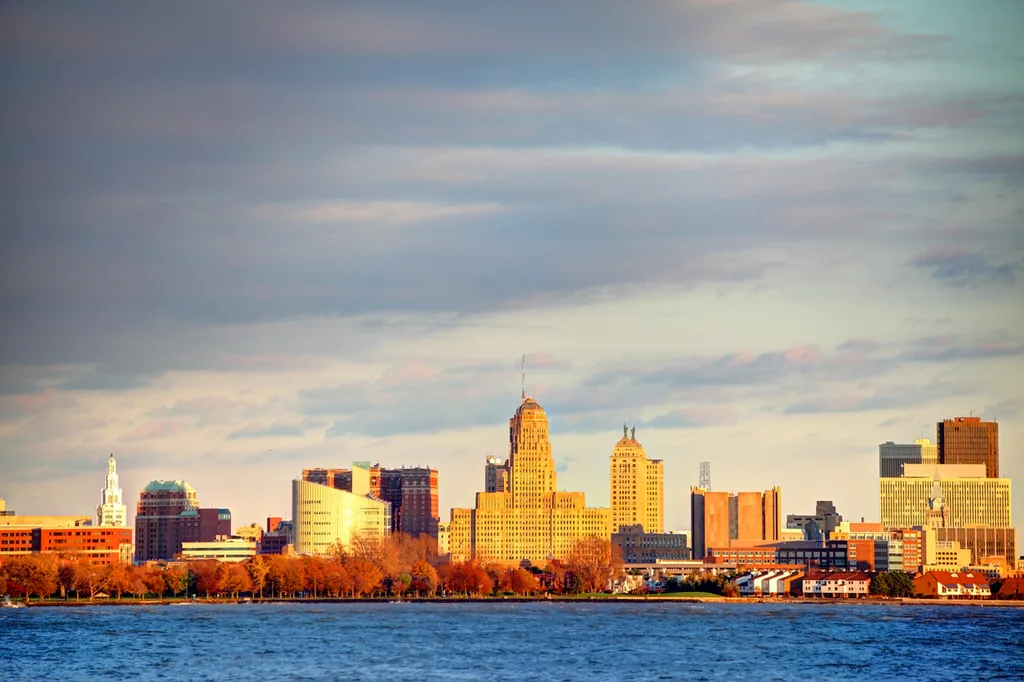
Buffalo, NY Solar Panels
In This Guide

Solar Power in Buffalo
Planning solar panel installation in Buffalo, NY means looking beyond snowfall. Roof condition, shade from nearby trees or buildings when the sun is lower in winter, and year-round electricity use all help shape a system.
Explore how panels work and what to consider for your home in our guide to home solar panels.
How Much Do Solar Panels Cost in Buffalo, NY?
Explore solar installation costs in Buffalo with an estimate informed by Palmetto’s real installation data from the area, including nearby Amherst, Cheektowaga, Tonawanda, and West Seneca. See how local costs may shape your project, without treating an estimate as a final quote.
System
- No upfront investment
- Palmetto handles all maintenance
- 90% Production Guarantee
- Comprehensive protection program included
Key Takeaways
- Buffalo’s snowy winters don’t rule out solar—roof condition, shade, and seasonal sunlight all shape how much a home system can produce.
- Solar output changes with the seasons: longer summer days can boost production, while cloudy weather and shorter winter days can reduce it.
- Costs and savings depend on your home; compare purchase and lease estimates, and check which New York incentives and utility credits may apply.
Buffalo Electricity Prices
Electricity prices have climbed in New York, making energy costs worth considering for Buffalo homeowners exploring solar.
The chart shows New York rates rising from 19.5 cents per kilowatt-hour in 2021 to 24.4 cents in 2024. The national average also increased, from 13.7 to 16.5 cents per kilowatt-hour.
These figures are statewide, not specific to Buffalo. A home solar system can generate some electricity on-site, potentially reducing how much power a household buys from its utility and its exposure to rate increases.
Over time, solar may help offset electricity costs, but results vary with system price, household use, roof conditions, and energy production. Comparing those factors can help Buffalo homeowners assess the potential long-term value.
Price of Energy: New York vs National Average
Buffalo Area Utility Providers
In Buffalo, electricity customers may be served by NYSEG or National Grid. The latest utility figures provided are for 2023; 2024 data is not yet available. Rates are compared with 2023 national and New York State averages.
In 2023, NYSEG’s 15.5¢ per kWh was below the national average of 16.0¢ and state average of 22.20¢. National Grid’s 17.0¢ was above the national average but below the state average.
These figures show utility prices varied relative to broader averages, but they do not explain why. Electricity rates are one factor Buffalo households can consider when evaluating whether solar may help offset grid electricity use.
Buffalo Utilities Electricity Rates
New York Solar Incentives
Buffalo homeowners can explore state and local programs that may reduce solar costs. See the table of solar incentives in New York for an overview.
Options include income-qualified upfront rebates, a state income-tax credit, sales- and property-tax exemptions, battery rebates, community-solar bill credits, and utility compensation through net metering or the Value Stack. Eligibility and funding vary.
Though the federal 30% residential credit was eliminated by the Big Beautiful Bill, New York incentives remain. LightReach leasing: Palmetto handles the commercial ITC and passes savings through lower payments.
| Incentive | Type | Description | Source |
|---|---|---|---|
| NY-Sun Affordable Solar Residential Incentive | Upfront solar rebate | Eligible income-qualified homeowners and qualifying affordable housing may receive a contractor-applied NY-Sun incentive of $0.80 per watt upstate and in Con Edison territory, or $0.40 per watt on Long Island, subject to program rules and available funding. | |
| New York State Solar Energy System Equipment Credit | State income tax credit | Qualifying taxpayers may claim 25% of eligible residential solar expenditures, up to $5,000, for a qualifying system installed and used at their New York principal residence. | Learn More |
| New York Residential Solar Sales-Tax Exemption | Sales tax exemption | Qualifying residential solar energy equipment and installation are exempt from New York State and Metropolitan Commuter Transportation District sales tax, although some local sales taxes still apply. | Learn More |
| New York Residential Energy-Storage Sales-Tax Exemption | Sales tax exemption | Qualifying residential energy-storage equipment and installation are exempt from state and local sales and use taxes from June 1, 2024 through May 31, 2028. | Learn More |
| New York Real Property Tax Law §487 Renewable-Energy-System Exemption | Property tax exemption | A qualifying solar energy system or approved electric energy-storage system may receive a 15-year exemption from property taxes on the increase in assessed value attributable to the system, subject to local adoption and other rules. | Learn More |
| NYSERDA Residential Energy Storage Incentive | Battery storage rebate | Eligible homeowners may receive a block-funded, per-kWh incentive through an approved contractor for a new grid-connected residential battery, generally capped at 25 kWh and subject to regional rates and funding. | |
| NYSERDA Residential Inclusive Storage Incentive | Battery storage rebate | Qualifying residential storage projects meeting NYSERDA’s inclusive-eligibility criteria may qualify for a higher block-based incentive; the initial incentive block was set at $450 per kWh, subject to current availability and approval. | |
| Statewide Solar for All Household Bill Credits | Community solar bill credits | Income-eligible utility customers can receive bill credits from participating community-solar projects at no cost, in addition to any utility Energy Affordability Program benefit. | |
| New York Distributed Solar Compensation: Net Energy Metering and Value Stack | Net metering / net billing | Eligible New York solar customers may receive bill credits through utility net energy metering or monetary Value Stack compensation, depending on the project, utility tariff, and location. | Learn More |
NYSERDA’s NY-Sun program provides an upfront incentive that is generally applied through a participating contractor rather than paid to the homeowner after installation. The 2026 program manual lists rates of $0.80 per watt of solar nameplate capacity upstate and in Con Edison territory, and $0.40 per watt on Long Island.
Residential eligibility is limited to qualifying Affordable Solar projects. Income qualification generally uses household income below 80% of Area Median Income or State Median Income, whichever is higher, or specified categorical eligibility. Other customer and project rules apply.
Incentives depend on regional program blocks and available funds. Have a participating contractor verify eligibility, the applicable rate, and whether the block is open before signing a contract.
The New York State credit is 25% of qualified solar energy system expenditures, up to a maximum credit of $5,000. The system must use solar radiation to provide energy for residential use and be installed and used at the taxpayer’s principal residence in New York.
Depending on the arrangement, a taxpayer who purchases a system, leases it under a written agreement, or has a qualifying long-term written power-purchase agreement may be eligible. The credit is nonrefundable, and unused credit can generally be carried forward for up to five years.
This is a solar-equipment credit; state guidance does not clearly establish a separate credit for a standalone battery. Do not assume a battery-only purchase qualifies, and consult the Tax Department or a tax professional about storage installed with solar.
Qualifying residential solar energy system equipment and installation are exempt from New York’s 4% state sales tax and the 3/8% Metropolitan Commuter Transportation District tax. This reduces the upfront cost of an eligible residential solar installation.
The exemption does not eliminate every local sales tax. New York identifies jurisdictions where local tax continues to apply, so the final tax treatment depends on where the equipment is installed.
Ask the installer to itemize the equipment, installation, and applicable taxes on the contract. Separate rules can apply to electricity sold under a written solar power-purchase agreement.
New York exempts qualifying residential energy-storage equipment and its installation from state and local sales and use taxes for purchases or installations within the statutory period, June 1, 2024 through May 31, 2028. The exemption can reduce the purchase and installation cost of an eligible home battery.
This is a separate exemption from the state’s residential solar-equipment sales-tax exemption. Confirm that the equipment and installation meet the Tax Department’s requirements and that the seller applies the exemption correctly.
Under Real Property Tax Law §487, a qualifying solar energy system or approved electric energy-storage system may be exempt from property taxes on the increase in assessed value attributable to the installation for up to 15 years. The exemption is based on the system’s effect on assessed value, not the full property assessment.
This is a local-option benefit: municipalities and school districts may opt out, and a payment-in-lieu-of-taxes agreement or other local rules may affect eligibility. Local adoption and opt-out status should be checked for both the solar and storage components.
Eligible property owners generally apply through the state RP-487 process and must meet filing deadlines. Check with the local assessor before installation or promptly afterward to confirm the application requirements.
NYSERDA’s Residential Energy Storage Incentive provides an upfront, per-kWh incentive for eligible new, grid-connected home battery systems. The incentive is paid through a participating contractor, and eligible systems may generally receive support for up to 25 kWh of installed storage capacity.
Rates and remaining funding vary by region and incentive block. The program can support batteries paired with new or existing on-site generation and, where program rules allow, standalone storage. Long Island’s single-family program is for PSEG Long Island customers and requires the battery to be paired with solar; program block availability and requirements can differ from other regions.
Some utility territories and application dates have additional utility battery-program enrollment requirements. Ask an approved contractor to confirm the live rate, block status, capacity limits, utility requirements, and project eligibility before signing.
The Residential Inclusive Storage Incentive is a higher-rate NYSERDA incentive for qualifying residential battery projects. The initial block was set at $450 per kWh; at 25 kWh, that rate would calculate to $11,250 before applicable program limits. The actual award depends on current block availability and project approval.
Projects must meet the underlying residential storage requirements and at least one inclusive-eligibility criterion. Examples include location in a New York disadvantaged-community census tract, an eligible owner-occupied household below the applicable 80% AMI/SMI income threshold, or qualifying small affordable housing.
Rates, documentation, caps, and available funds are governed by the current NYSERDA manual and dashboard. Have the participating contractor verify the project’s eligibility and current incentive amount before relying on a quoted benefit.
Statewide Solar for All is a bill-credit program for eligible households, not a rooftop solar installation rebate. Participants receive credits on their utility bills associated with qualifying community solar, which can lower electricity costs without installing panels or a battery at home.
Eligibility and enrollment depend on program rules and utility territory. Customers enrolled in a utility Energy Assistance Program may be automatically enrolled where the program is operating; other customers may need to establish eligibility and provide documentation.
The bill credits are separate from rooftop-system incentives and from any utility affordability benefit. Confirm that the program is operating for your utility and review the enrollment and bill-credit terms before participating.
New York’s main solar export-compensation mechanisms include Phase One Net Energy Metering and the Value Stack, also known as Value of Distributed Energy Resources compensation. Under applicable net-metering tariffs, eligible customer-sited systems generally receive utility bill credits for exported electricity. Tariffs determine eligibility, credit treatment, and system limits.
The Value Stack credits eligible exports in monetary amounts based on components such as energy, capacity, environmental value, and location-specific grid benefits. Its value varies by utility, location, and time. It is an important compensation mechanism for community-distributed generation and may be available as an alternative for some on-site systems; export credits are not necessarily equal to the retail electricity rate.
Residential and small-commercial systems interconnected on or after January 1, 2022 may also incur a monthly Customer Benefit Contribution based on system capacity. This is a bill charge, not an incentive, and rates can change annually. Check the applicable utility tariff and current rate before estimating project savings.
Ready to start saving with solar?
Speak with a Palmetto solar expert to find out exactly how much you can save with New York incentives.
Get a Free QuoteBuffalo Solar Irradiance
Solar panel production varies throughout the year based on daylight hours, weather patterns, and sun intensity. Understanding how seasons affect your solar system helps set realistic expectations for your investment.
Buffalo’s cloudy winters, lake-effect snow, and shorter days can reduce solar output, while longer summer days boost it. With a well-designed system, Buffalo can still be a great place for solar.
Solar Production in Buffalo by Month
What Can Your Solar System Power?
Summer Production (July)
In July, your 10 kW system could power:
- 3.6 average homes (15 kWh/day per home)
- or Run central AC for 18 hours AND power all other appliances
- or Fully charge 5.4 Tesla Model 3 electric vehicles
Winter Production (December)
In December, your 10 kW system could power:
- 2 average homes (15 kWh/day per home)
- or Keep your home heating system running for 15 hours
- or Fully charge 3 Tesla Model 3 electric vehicles
Annual Production
Over a year, your 10 kW system could:
- Offset 10 tons of carbon dioxide emissions
- or Equal the environmental benefit of planting 175 trees
- or Save approximately $4,234 in electricity costs
Want to know exactly how much solar can power your home?
Get a personalized solar analysis based on your actual home, energy usage, and roof characteristics.
Get My Custom EstimateSolar Panel Systems in Buffalo
We’ve organized solar installation data across the country to create this interactive map of Buffalo. Explore the hexagons to see how many homes have gone solar in each area, and discover the neighborhoods and communities whose residents are making the switch to solar.
How to Choose a Solar Installer in Buffalo
Verify the license
New York does not require a statewide solar-installer license. Local authorities may require a home-improvement or electrical license, so ask the installer which licenses apply to your project and who will perform the work. New York lists home-improvement contractor licensing requirements for Buffalo, New York City, and Nassau, Suffolk, Putnam, Rockland, and Westchester counties. You can check state-issued licenses through the New York State license lookup, but it does not verify local contractor licenses. Confirm any local requirements with your city, town, village, or county.
Look for certified installers
Ask whether the people designing and installing your system hold current NABCEP certifications, and which credential they have. Certification can be an additional indicator of training and qualifications; it is not a substitute for any local license your project requires. Ask whether the installer is certified by the panel or inverter manufacturers quoted, what that certification covers, and whether it affects access to product support or warranty service. Compare the answers across companies rather than treating a credential as a guarantee of workmanship.
Compare quotes the same way
Request written proposals with the same assumptions. Compare:
- System size: the proposed capacity in kilowatts (kW) and the price per watt.
- Equipment: panel and inverter brands and models.
- Expected output: estimated production in kilowatt-hours per year (kWh/year), plus the assumptions behind the estimate.
- Coverage: panel product and performance warranties, inverter warranty, workmanship coverage, and coverage for roof penetrations. Check who handles a claim and for how long.
- Project responsibilities: who obtains permits and submits and follows up on the utility interconnection application.
- Payment: total cost or monthly payment, all included charges, and any payment escalator. Ask how ownership and maintenance responsibilities differ between purchase and lease options.
Permits, interconnection and your HOA
For ordinary residential rooftop solar, required building or electrical permits come from the local authority having jurisdiction, typically a city, town, or village building department, and sometimes a county. The statewide Unified Solar Permit is available only where adopted locally. The New York State Public Service Commission sets the interconnection process; your electric utility reviews and processes the application under statewide and applicable utility-specific requirements. Confirm which utility serves your address; examples in New York include Consolidated Edison Co-NY Inc, Niagara Mohawk Power Corp., Long Island Power Authority, and New York State Elec & Gas Corp. Ask your installer to identify the permitting and interconnection steps and provide status updates. New York Real Property Law § 342 generally bars an HOA from effectively prohibiting or unreasonably limiting rooftop photovoltaic systems rated 25 kW or less, except on HOA-owned or commonly owned property. Applicable safety rules and permits still apply.
Red flags
- Pressure to sign the same day or accept terms before you can review the proposal.
- A company that cannot explain required local licensing, or out-of-state crews with no clear explanation of who is responsible for local permits and the work.
- Vague production estimates, without a written annual kWh estimate and its assumptions.
- A large upfront deposit without a clear written schedule of payments and project milestones.
- Promises that a homeowner can claim a federal tax credit for a purchase in 2026; homeowner credits ended December 31, 2025.
Leasing Solar Panels
For Buffalo-area homes served by National Grid or New York State Electric & Gas (NYSEG), a solar lease is available through select partners. Availability depends on your utility and provider, so confirm options for your address. The listed option is a lease, not a power purchase agreement (PPA).
With a lease, you typically pay a set monthly amount for the solar system’s expected production. A PPA instead charges per kilowatt-hour generated, so payments can change with seasonal output. Learn more about buying or leasing solar.
A lease may avoid the large upfront cash purchase and, under the agreement, the system owner handles maintenance. Paying cash means owning the system and arranging or paying for upkeep yourself. Review responsibilities and terms in Palmetto LightReach details.
Go solar without the investment
With LightReach, there are no investment costs to recoup, loan payments to manage, or maintenance needs to take on. As soon as your panels are active, your solar savings are too!
Explore LightReach LeasingFrequently Asked Questions
Yes. Buffalo homeowners served by National Grid or NYSEG can receive 1:1 net metering credits under the applicable utility tariff. Each month, electricity sent to the grid offsets electricity used from the grid.
Unused credits carry forward from month to month and year to year, for up to 20 years, but are not paid out by check. A monthly Contribution Benefits Charge also applies: currently listed as $1.45 per kW-DC for National Grid and $1.16 per kW-DC for NYSEG. Confirm current terms with your utility.
Yes, an owned solar panel system may increase a Buffalo home’s resale value, though no premium is guaranteed. Zillow’s national study found homes with solar sold for about 4.1% more; that is not a Buffalo-specific estimate.
This potential value applies to panels you own, such as a cash-purchased system. A leased system does not transfer as owned equipment, and resale may differ if a buyer must assume the lease agreement. Roof condition, shading, and system performance also matter in Buffalo.
Buffalo homeowners can go solar with a LightReach lease for no upfront cost and a low fixed monthly payment. The calculator estimates $76–$139 per month by home size, including $102 per month for a medium home.
A cash purchase is another option: estimated costs after listed New York incentives range from $16,301 to $31,992 ($22,968 for a medium home). The federal 30% residential solar tax credit is no longer available for cash purchases following the 2025 law change. See the calculator above for details.
Leasing lets you use a solar system for a set monthly payment without buying it; LightReach has no upfront cost. In Buffalo, a typical 9.43 kW system is estimated at about $102/month, based on New York’s 1,043 kWh/kW annual production ratio and a $0.125/kWh rate.
The payment includes the panels, installation, monitoring, maintenance, and Palmetto’s protection program with a 90% production guarantee. Lease payments are typically less than current electricity bills, so savings may start right away, though utility charges may still apply.
There is no single best solar installer for every Buffalo home. The right fit depends on your roof’s condition and shade, expected seasonal production, system design, warranties, and financing terms.
Palmetto Solar is an established option for Buffalo homeowners: we have completed 2,278 installations in New York since 2020 and use an installation network. We offer financing options; compare proposals and contract terms to find what suits your home and budget.
Yes. Solar panels work in Buffalo, NY. The article estimates about 4.2 peak sun hours per day on average. Panels can still produce electricity in cloudy daylight, though cloud cover and snow on the panels can reduce output.
Production changes by season: longer summer days mean more energy, while Buffalo’s shorter, cloudier winter days mean less. For example, the article’s modeled 10-kW system averages about 46.7 kWh per day in July and 13.7 kWh per day in December.
Buffalo homeowners may qualify for New York’s income-based NY-Sun upfront rebate, a state solar tax credit of 25% of eligible costs (up to $5,000), and sales-tax exemptions. A locally adopted property-tax exemption may exclude the added assessed value of solar or storage for up to 15 years. Battery rebates and storage sales-tax relief may also apply.
Eligible utility customers can receive community-solar bill credits; rooftop systems may earn credits through net metering or the Value Stack. The federal 30% residential credit is no longer available for cash purchases after the 2025 law change. With LightReach leasing, Palmetto claims the commercial ITC and passes savings through.