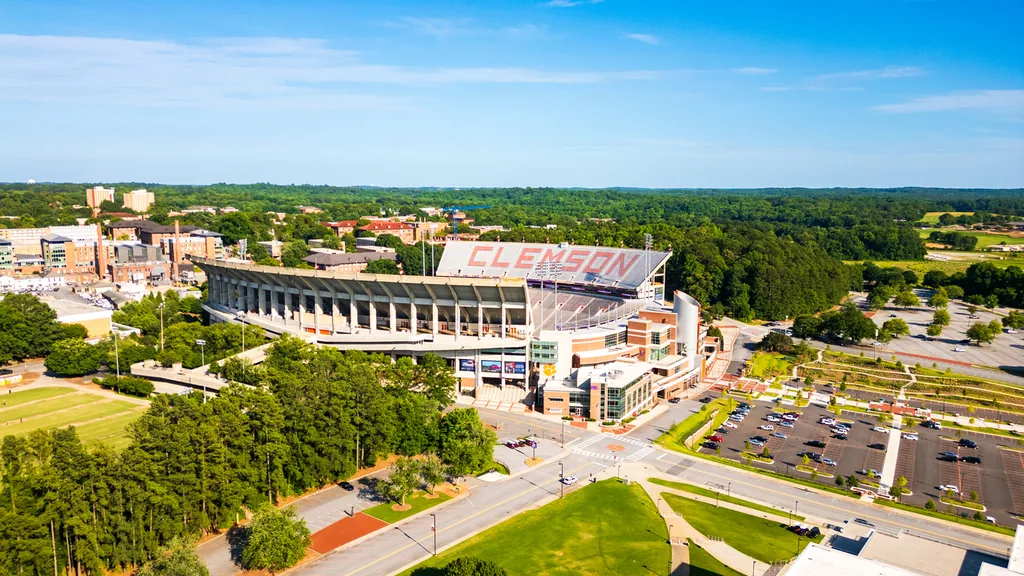
Clemson, SC Solar Panels
In This Guide

Solar Power in Clemson
Thinking about solar installation in Clemson, SC? Roof direction, tree shade, household energy use, and your electricity rate and utility rules can all affect how a solar system could fit your home.
Learn how these factors shape a project and what to consider before getting started in our guide to home solar panels.
SOUTH CAROLINA by the Numbers
How Much Do Solar Panels Cost in Clemson, SC?
Explore solar installation costs in Clemson using Palmetto’s records of real solar projects across South Carolina. Local data helps you compare likely costs for homes in Clemson and nearby communities like Central, Pendleton, Six Mile, and Seneca, rather than relying only on broad national averages.
System
- No upfront investment
- Palmetto handles all maintenance
- 90% Production Guarantee
- Comprehensive protection program included
Key Takeaways
- Solar can work in Clemson, but every home is different—roof direction, shade, energy use, utility rules, and seasonal sunlight affect system size and results.
- Local estimates can help you compare costs and potential savings—a typical 7.38 kW system is estimated at about $17,436 after the state incentive, with savings varying by home.
- Incentives and solar billing depend on your utility and system ownership—check current program rules and compare purchase and PPA terms before deciding.
Clemson Electricity Prices
Electricity prices in South Carolina have climbed in recent years, making future bills worth considering for Clemson households.
State electricity prices rose from 12.9 cents per kilowatt-hour in 2021 to 14.1 cents in 2024. These South Carolina figures provide context, not a Clemson-specific rate.
A home solar system can generate some of the electricity a household uses, potentially reducing how much it buys from the utility and its exposure to rate increases. Results depend on system output, usage, and utility rules.
Over time, producing power at home may help make energy costs more predictable, though savings are not guaranteed. Comparing a system’s cost and expected output with local electricity rates can clarify its long-term value.
Price of Energy: South Carolina vs National Average
Clemson Area Utility Providers
For Clemson, SC, Duke Energy is the utility represented in the available local data. Its 2023 electricity rate was 12.7¢ per kilowatt-hour (kWh); 2024 figures were not yet available.
That was below South Carolina’s 2023 average of 13.70¢/kWh and the national average of 16.0¢/kWh. These comparisons describe 2023 rates, not current prices or explanations for rate differences.
For Clemson households, electricity rates help frame the value of solar: generating some electricity at home may reduce reliance on utility power, while the impact depends on household use and system performance.
Clemson Utilities Electricity Rates
South Carolina Solar Incentives
Solar installation in Clemson, SC may qualify for state or utility incentives, depending on system ownership, utility, and program rules. See the solar incentives in South Carolina below.
Options include the nonrefundable state income-tax credit (25% of eligible costs, with annual limits and a 10-year carryforward), utility-specific export credits, Santee Cooper solar rebates and community-solar subscriptions, and Dominion community-solar credits. Duke Energy’s battery payments apply to qualifying nonresidential participants.
Program availability depends on utility and eligibility. LightReach leasing can simplify incentives: Palmetto handles the commercial ITC and passes savings through as lower monthly payments.
| Incentive | Type | Description | Source |
|---|---|---|---|
| South Carolina Solar Energy System Credit (TC-38) | State Income Tax Credit | South Carolina taxpayers who own and install a qualifying solar system may claim a nonrefundable credit of 25% of eligible costs, subject to annual limits and a 10-year carryforward. | Learn More |
| South Carolina Solar Choice and Utility-Specific Net Metering / Export Compensation | Net Metering / Net Billing | Solar customers may receive bill credits for exported electricity under utility-specific tariffs, but South Carolina does not provide one uniform statewide export-credit rate. | Learn More |
| Duke Energy PowerShare Storage (South Carolina nonresidential program) | Utility Battery Storage Demand Response Incentive | Participating South Carolina nonresidential customers with qualifying battery storage may receive enrollment, monthly capacity, renewable-charging, and curtailment-event payments. | Learn More |
South Carolina’s TC-38 credit is 25% of eligible solar system purchase and installation costs. The amount used in a tax year is limited to the lesser of $3,500 per facility or 50% of the taxpayer’s South Carolina income-tax liability; unused credit may be carried forward for up to 10 years. The credit is nonrefundable.
The taxpayer must own the qualifying system installed at a facility in South Carolina, so a renter or a customer whose system is leased generally cannot claim the credit. Eligible costs may include equipment and installation expenses. SCDOR guidance says a battery connected to a solar system and charged entirely by solar may qualify; a standalone or grid-charged battery does not qualify under that guidance. Claimants should review the current TC-38 instructions and retain invoices and system documentation.
South Carolina’s solar billing benefit depends on the electric utility, the customer’s tariff, and sometimes the date of the interconnection application. Investor-owned utilities use Solar Choice or other approved tariff options; credits for exported energy can depend on time of use, and fixed or non-bypassable charges may still apply. Older customers may have different transition or grandfathering terms.
Before signing an installation contract, homeowners should obtain the applicable tariff in writing and check export-credit values, monthly charges, annual or monthly true-up rules, and any battery-export limits.
Duke Energy’s PowerShare Storage program is for qualifying nonresidential customers in South Carolina; it is not a residential battery rebate. Published payment terms include a one-time $120 per enrolled kilowatt connectivity credit, an additional $30 per kilowatt when the battery is charged using renewable energy, $3.50 per enrolled kilowatt per month subject to a system-loss factor, and $0.10 per kilowatt-hour for energy used during curtailment events.
Participants allow Duke to dispatch enrolled storage during approximately 30–36 events per year, with each event lasting up to four hours. Businesses should confirm eligibility, enrollment availability, equipment requirements, and final payment calculations directly with Duke Energy.
Ready to start saving with solar?
Speak with a Palmetto solar expert to find out exactly how much you can save with South Carolina incentives.
Get a Free QuoteClemson Solar Irradiance
Solar panel production varies throughout the year based on daylight hours, weather patterns, and sun intensity. Understanding how seasons affect your solar system helps set realistic expectations for your investment.
Though afternoon storms and shorter winter days affect output, Clemson’s sunny climate supports solar, and a well-designed system can produce useful power year-round.
Solar Production in Clemson by Month
What Can Your Solar System Power?
Summer Production (July)
In July, your 10 kW system could power:
- 3.6 average homes (15 kWh/day per home)
- or Run central AC for 18 hours AND power all other appliances
- or Fully charge 5.4 Tesla Model 3 electric vehicles
Winter Production (December)
In December, your 10 kW system could power:
- 2 average homes (15 kWh/day per home)
- or Keep your home heating system running for 15 hours
- or Fully charge 3 Tesla Model 3 electric vehicles
Annual Production
Over a year, your 10 kW system could:
- Offset 10 tons of carbon dioxide emissions
- or Equal the environmental benefit of planting 175 trees
- or Save approximately $4,234 in electricity costs
Want to know exactly how much solar can power your home?
Get a personalized solar analysis based on your actual home, energy usage, and roof characteristics.
Get My Custom EstimateSolar Panel Systems in Clemson
We’ve organized address-level solar installation data from across the United States and are excited to share it here. Explore the map to see how many Clemson-area households have gone solar in each neighborhood, and discover the neighbors and communities making the switch to solar.
How to Choose a Solar Installer in Clemson
Verify the license
South Carolina does not issue one single solar-contractor license. Residential solar work requires credentials that cover the work being performed, overseen by the South Carolina Department of Labor, Licensing and Regulation (LLR), principally its Residential Builders Commission. Electrical work requires a residential-builder specialty registration with an electrical classification or a residential-builder license. Roof-mounted systems also require the appropriate roofing specialty registration or a residential-builder license; added structural framing may require a carpenter classification.
Ask the installer for the license or registration details for the company and the people doing the work, then confirm that the credentials cover your project with LLR. The state explains the requirements in its solar installer licensing guidance.
Look for certified installers
Ask whether the people designing or installing your system hold a relevant North American Board of Certified Energy Practitioners (NABCEP) certification, and verify what credential they hold through NABCEP. Also ask about manufacturer certifications for the proposed panels or inverters. These can indicate product-specific training or authorization, but they are not a substitute for required South Carolina credentials. Compare the actual experience and qualifications of the crew assigned to your home, not only the salesperson’s credentials.
Compare quotes the same way
Request written quotes with the same assumptions and compare the details, not just the headline price. Check whether each proposal includes:
- System size in kilowatts (kW) and total price per watt, calculated on the same basis.
- Panel and inverter brands and models.
- Estimated annual production in kilowatt-hours (kWh/year), and the assumptions behind that estimate.
- Warranty terms for panel product and performance, inverter, workmanship, and roof penetrations.
- Who will obtain permits and submit the utility interconnection application.
- Total cost or monthly payment, plus any payment escalator and the terms that explain how it changes.
Ask each installer to explain differences in system design, production estimates, warranty coverage, and included work before deciding.
Permits, interconnection and your HOA
Building and electrical permits are handled by the local authority having jurisdiction, typically a city or county building-code office; requirements depend on your property’s jurisdiction. For utility interconnection, you or your installer apply to the electric utility serving the property. South Carolina utilities include Dominion Energy South Carolina, Duke Energy Carolinas, South Carolina Public Service Authority, and Duke Energy Progress (NC); confirm which provider serves your address and what its application requires.
South Carolina has no enacted law preventing an HOA from banning or restricting residential rooftop solar, and state guidance says HOAs may restrict panel placement. Review your HOA’s rules and ask about its approval process before signing or ordering equipment.
Red flags
- Pressure to sign the same day or claims that an offer is available only if you decide immediately.
- Crews whose South Carolina credentials you cannot verify, including unlicensed or out-of-state crews.
- Vague production estimates without a clear annual kWh figure and explanation.
- A large upfront deposit without clear written terms for what it covers and when work will proceed.
- Promises that homeowners can claim federal tax credits for purchases in 2026; homeowner credits ended December 31, 2025.
Leasing Solar Panels
For Clemson homeowners served by Duke Energy Carolinas, Palmetto LightReach offers a solar power purchase agreement (PPA). Availability depends on your utility and address, so confirm your provider before comparing options. Learn more about LightReach.
With a PPA, you pay for the electricity your panels produce at an agreed price per kilowatt-hour, rather than paying a fixed monthly lease amount. Payments can vary by season as solar production changes. Read more about buying or leasing solar.
Unlike paying cash to own a system, a PPA generally avoids the upfront purchase cost. Palmetto retains system ownership and handles maintenance under the agreement, so you don’t take on the same repair responsibilities as a cash owner. Review the contract for payment terms, coverage, and any remaining utility charges.
Go solar without the investment
With LightReach, there are no investment costs to recoup, loan payments to manage, or maintenance needs to take on. As soon as your panels are active, your solar savings are too!
Explore LightReach LeasingFrequently Asked Questions
Yes. Clemson homeowners served by Duke Energy Carolinas can receive credits for solar electricity sent to the grid, but the terms depend on the utility and tariff. Duke’s current monthly plan requires a time-of-use rate: exported electricity offsets electricity bought during the same time period, one-for-one within that billing month.
Any remaining excess is credited at a lower rate, roughly 2.7–4 cents per kWh, and can roll over to later bills. A minimum monthly bill applies, and older 1:1 net metering ended in 2021. Check your Duke tariff, since service and rates can vary by address.
Yes. An owned solar panel system may increase a home’s value in Clemson, SC, though the amount varies. Zillow’s study found homes with solar sold for about 4.1% more on average; this national finding is not a guaranteed local premium.
This potential value applies to systems the homeowner owns, not leased or third-party-owned systems. A leased system may affect resale differently because the buyer may need to assume its agreement.
In Clemson, homeowners can go solar with a LightReach lease for a low fixed monthly payment and no upfront cost. The calculator estimates $93 per month for a typical 7.38 kW system; home size and energy needs affect pricing.
Cash purchase is another option. The calculator estimates about $17,436 after the listed South Carolina incentive for a typical system. The federal 30% residential solar tax credit is no longer available for cash purchases following the 2025 federal law change. See the calculator above for estimates by home size.
With Palmetto LightReach, you pay a monthly amount to use a solar system, with no upfront cost. One payment covers the panels, installation, monitoring, maintenance, and protection, including a 90% Production Guarantee.
In Clemson, a typical 7.38 kW system is estimated at about $93 per month, based on South Carolina’s production ratio of 1,442 kWh per kW per year and a rate of $0.105/kWh. Actual terms vary; payments are typically less than the current electricity bill, so savings may begin when the system is active.
Yes, solar can make sense in Clemson, SC, where sunny conditions support year-round production. Whether solar panel installation is worthwhile for your home depends on roof direction, tree shade, electricity use, utility billing rules, and system cost.
Local estimates for a typical 7.38 kW system project about $43,000 in savings over 25 years, though results vary. LightReach, Palmetto’s solar lease program, removes the upfront cost barrier entirely: homeowners can go solar with no money down and start saving from day one.
A typical 7.38-kW solar system in Clemson could produce about 10,500 kWh of electricity per year, or roughly 29 kWh per day on average. The article’s NREL-based estimate is about 9,969 kWh annually for a 7-kW system.
Actual output varies with roof direction and pitch, tree shade, weather, and season. Clemson systems generally produce more in sunnier summer months and less during shorter, cloudier winter days.
Palmetto Solar is a solar installation option for Clemson homeowners. We combine national resources with local experience, including 1,145 installations in South Carolina since 2020, and offer financing options through our installation network.
The right system depends on your roof’s direction and shade, household energy use, and utility billing rules. Compare system designs, full costs, financing terms, and service coverage to determine what best fits your Clemson home.