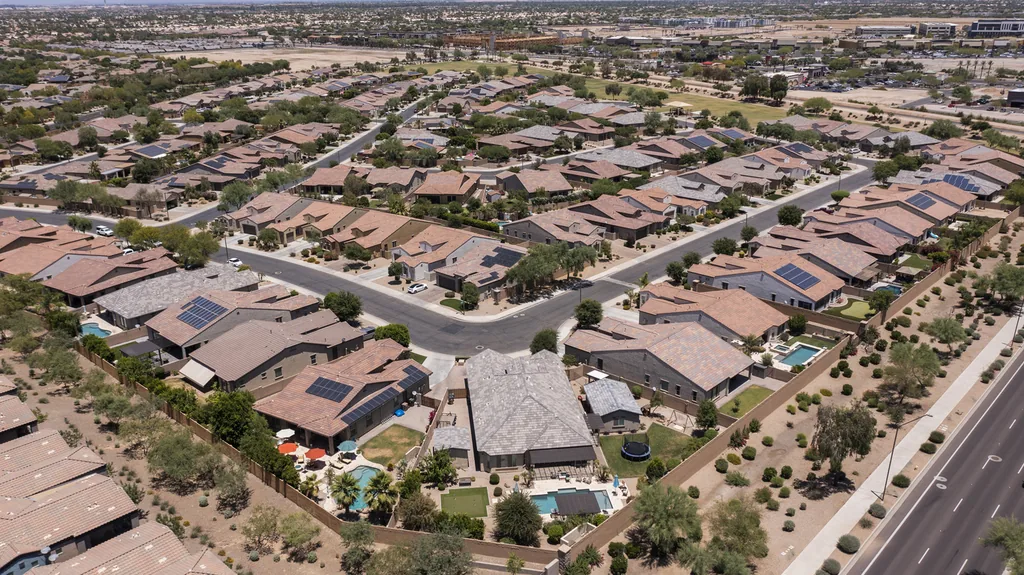
Goodyear, AZ Solar Panels
In This Guide

Solar Power in Goodyear
Considering solar installation in Goodyear, AZ? The area’s abundant sunshine makes solar worth exploring, but roof condition, orientation, shading, and household energy use all help determine how a system should be designed.
Arizona ranks third in the nation for residential solar installations, reflecting strong interest across the state. Start with our guide to home solar panels, then learn what to consider for a Goodyear installation.
How Much Do Solar Panels Cost in Goodyear, AZ?
Explore what solar installation may cost in Goodyear using real installation data from Palmetto projects in the area. This calculator draws on local data from communities such as Estrella, Palm Valley, PebbleCreek, and Canyon Trails to give you a useful starting point for understanding solar costs.
System
- No upfront investment
- Palmetto handles all maintenance
- 90% Production Guarantee
- Comprehensive protection program included
Key Takeaways
- Goodyear’s sunshine supports solar, but each home is different. Roof direction, shade, energy use, and seasonal weather affect system design and production.
- Solar costs and savings depend on your home and utility. Compare system estimates with your electricity use and rate plan.
- Arizona incentives and solar export credits have specific rules. The state tax credit is capped at $1,000, and utility compensation varies by provider and plan.
Goodyear Electricity Prices
Electricity rates can shape household budgets, making Arizona’s recent price trend worth a closer look for Goodyear residents.
Statewide, Arizona’s average residential electricity price rose from 12.5 cents per kilowatt-hour in 2021 to 14.9 cents in 2024. The adjacent chart compares this trend with the national average; these are state, not Goodyear-specific, figures.
A home solar system can supply some of a household’s electricity, potentially reducing how much power it buys from the utility. The effect depends on system production, energy use, and applicable utility rules.
Over time, using solar power may help limit a household’s exposure to future utility-rate changes. Its overall value depends on installation costs, system performance, electricity use, and how rates change.
Price of Energy: Arizona vs National Average
Goodyear Area Utility Providers
In Goodyear, electricity service may come from APS or SRP. The latest figures available here are from 2023: APS averaged 15.3¢ per kWh and SRP 12.5¢.
In 2023, Arizona averaged 14.0¢ per kWh and the national average was 16.0¢. APS was above the state average but below the national average; SRP was below both.
These rates offer context, but a household’s bill also depends on electricity use. Comparing usage with a potential solar system’s production can help Goodyear homeowners assess whether solar may fit their needs.
Goodyear Utilities Electricity Rates
Arizona Solar Incentives
Goodyear homeowners may find state and utility-based programs that help offset solar costs. See the table below for solar incentives in Arizona.
Arizona’s Form 310 offers a credit of 25% of qualifying solar-device costs, up to $1,000 per residence. Qualifying sales through registered solar retailers may receive TPT treatment, and on-site solar equipment may be excluded from property valuation. Export compensation varies by utility and tariff.
Eligible APS customers may earn $110 per average kW for May–October battery events; qualifying TEP customers may earn $120 per average kW per season. Programs depend on provider and eligibility.
| Incentive | Type | Description | Source |
|---|---|---|---|
| Arizona Credit for Solar Energy Devices (Form 310) | State Income-Tax Credit | Arizona residents may claim a credit of 25% of qualifying solar-device costs, up to $1,000 per residence, with unused credit generally carried forward for up to five consecutive years. | Learn More |
| Arizona Solar-Equipment Transaction Privilege Tax (TPT) Treatment | Sales-Tax Exemption / Deduction | The qualifying retail sale of a solar energy device may be excluded from the applicable Arizona TPT tax base when sold through a properly registered solar-energy retailer. | Learn More |
| Arizona Property Valuation Treatment for On-Site Solar | Property-Tax Valuation Exclusion | Qualifying on-site solar energy equipment is treated as adding no value to the property for appraisal purposes, reducing the risk that the solar system increases assessed property value. | Learn More |
| Arizona Solar Export Compensation and Interconnection Tariffs | Net Billing / Net Metering / Export Compensation | Arizona has no single statewide solar export rate; bill credits and compensation depend on the customer’s utility, rate plan, tariff, and sometimes interconnection history. | Learn More |
| APS Storage Rewards Pilot | Battery Demand-Response Reward | Eligible APS residential customers can earn $110 per average kilowatt of battery contribution for the May–October season through performance-based conservation-event rewards. | Learn More |
An Arizona resident who is not claimed as another taxpayer’s dependent may claim a credit equal to 25% of the cost of a qualifying solar energy device installed at the resident’s Arizona home, up to a maximum of $1,000. The $1,000 limit is cumulative for the same residence, rather than a new limit for each system.
Claim the credit using Arizona Form 310 and Form 301. Unused credit may generally be carried forward for up to five consecutive tax years. A solar system that includes storage may qualify, but a stand-alone battery is not clearly covered; check the current instructions or consult ADOR or a tax professional. See ADOR Form 310 information and A.R.S. § 43-1083.
Arizona law provides favorable TPT treatment for qualifying retail sales of solar energy devices. The practical benefit is potential avoidance of applicable transaction privilege tax on the qualifying equipment purchase; the exact tax treatment depends on the transaction and the retailer’s status.
This is not a blanket exemption for every installation, labor, or contracting charge. Confirm that the seller is registered as required and ask how the exemption is reflected on your invoice. See A.R.S. § 42-5061 and ADOR contracting guidance.
Arizona law provides that qualifying on-site solar equipment is considered to add no value to the property for appraisal purposes. This can help prevent a qualifying solar installation from increasing the property’s assessed value and resulting property-tax valuation.
This is a valuation rule, not a cash rebate or a direct reduction in the home’s existing assessed value. The law covers specified solar devices and grid-tied photovoltaic systems primarily used to produce energy for on-site consumption; do not assume a stand-alone battery receives the same treatment. See A.R.S. § 42-11054.
Goodyear homeowners should check APS’s current tariff before sizing a solar system: export compensation is utility- and plan-specific, and new customers generally should not assume they will receive retail-rate net metering. APS describes Resource Comparison Proxy (RCP) net-billing arrangements that credit excess generation at an applicable purchase rate; qualifying legacy customers may have different terms.
Check the current terms, rates, and interconnection requirements directly with your utility: APS renewable riders.
APS states that participants can earn $110 per average kW their battery provides during the season. For example, an average contribution of 3 kW would earn $330 for the season. This is a performance-based reward, not an upfront battery-purchase rebate.
Applicants must be APS residential rate-plan customers, have an APS-approved battery and permission to operate, and meet the program’s equipment and enrollment requirements. Events take place during the May–October season, and customers may opt out of individual events. Batteries without solar may qualify. Confirm current equipment eligibility and program terms with APS Storage Rewards.
Ready to start saving with solar?
Speak with a Palmetto solar expert to find out exactly how much you can save with Arizona incentives.
Get a Free QuoteGoodyear Solar Irradiance
Solar panel production varies throughout the year based on daylight hours, weather patterns, and sun intensity. Understanding how seasons affect your solar system helps set realistic expectations for your investment.
Goodyear’s abundant sunshine supports solar, though summer heat, monsoon clouds, and shorter winter days affect monthly output. Like cloudy cities, it can be great for solar with a well-designed system.
Solar Production in Goodyear by Month
What Can Your Solar System Power?
Summer Production (July)
In July, your 10 kW system could power:
- 3.6 average homes (15 kWh/day per home)
- or Run central AC for 18 hours AND power all other appliances
- or Fully charge 5.4 Tesla Model 3 electric vehicles
Winter Production (December)
In December, your 10 kW system could power:
- 2 average homes (15 kWh/day per home)
- or Keep your home heating system running for 15 hours
- or Fully charge 3 Tesla Model 3 electric vehicles
Annual Production
Over a year, your 10 kW system could:
- Offset 10 tons of carbon dioxide emissions
- or Equal the environmental benefit of planting 175 trees
- or Save approximately $4,234 in electricity costs
Want to know exactly how much solar can power your home?
Get a personalized solar analysis based on your actual home, energy usage, and roof characteristics.
Get My Custom EstimateSolar Panel Systems in Goodyear
We’ve organized solar installation data across the country and are excited to share a closer look at Goodyear. Explore the map to see how many solar installations are in each area and discover the neighborhoods and communities where your neighbors have made the switch.
How to Choose a Solar Installer in Goodyear
Verify the license
Paid residential solar work in Arizona generally requires an appropriate contractor license. Solar-device installers must meet the applicable solar-contractor qualifications, and the right license classification depends on the work. Ask which company holds the license for your project and confirm its status and scope with the Arizona Registrar of Contractors (AZ ROC); also ask your city or county what local approvals apply. The provided state information does not include a direct license-lookup link, so don’t rely on a salesperson’s verbal assurance. Make sure the agreement identifies the contracting company, not only a sales or financing partner.
Look for certified installers
Ask who will design and install the system, and whether those people hold NABCEP certifications. NABCEP credentials can indicate demonstrated training or qualifications in the solar field; they are a useful comparison point, not a replacement for an Arizona contractor license or a guarantee of workmanship. Ask what manufacturer certifications the installer holds, which products those certifications cover, and whether the people doing your installation have them. You can learn about NABCEP at NABCEP.org.
Compare quotes the same way
Request written proposals with the same details so you can compare scope, not just the monthly payment. Check whether the production estimate uses the same assumptions and whether each quote includes the same equipment and work.
- System size in kW and total price per watt.
- Panel and inverter brands and models.
- Estimated production in kWh per year, plus the assumptions behind it.
- Warranty terms for panel product and performance, inverter, workmanship, and roof penetrations.
- Who handles permits, inspections, and utility interconnection.
- Total cost or monthly payment, financing or lease terms, and any payment escalator.
Ask what happens if actual production differs from the estimate, and get any performance promise in writing.
Permits, interconnection and your HOA
Building and electrical permits and inspections are handled by the local authority having jurisdiction; the correct office and requirements depend on the property address. The homeowner or installer applies to the serving utility for interconnection and an agreement. Depending on your location, the utility may be Arizona Public Service Co, Salt River Project, Tucson Electric Power Co, or UNS Electric, Inc.; confirm which one serves your home. Requirements can differ, including for municipal electric systems. Ask who submits the application and confirm an interconnection agreement is in place before the system is connected.
Arizona law limits HOA and covenant restrictions on rooftop solar: associations may use reasonable placement rules, but those rules cannot prevent installation or impair function, use, cost, or efficiency. Some older instruments are excepted, and these protections do not create an easement over a neighbor’s property. See A.R.S. §§ 33-1816 and 33-439, and ask the installer how it will coordinate any HOA review.
Red flags
- Pressure to sign the same day or claims that an offer disappears immediately.
- An unlicensed installer, or out-of-state crews when the contracting company and Arizona license responsibility are unclear.
- Vague production estimates, or reluctance to explain assumptions and warranty exclusions.
- A large upfront deposit without a clear written payment schedule and scope.
- Promises that homeowners can claim federal tax credits for purchases in 2026; homeowner credits ended December 31, 2025.
For workmanship, abandonment, licensing, or an unlicensed contractor, complaints can go to the AZ ROC; deceptive or unfair sales and business practices can also be reported to the Arizona Attorney General’s Consumer Information and Complaints Unit. Palmetto is one installer homeowners can compare, including a lease option through LightReach.
Leasing Solar Panels
For Goodyear homeowners served by Arizona Public Service (APS) or Salt River Project (SRP), Palmetto lists a solar lease as available. Availability depends on your utility and address; a power purchase agreement (PPA) is not listed for these service areas.
With a lease, you pay an agreed fixed monthly amount based on estimated system production. Unlike paying cash, leasing does not require you to cover the full system cost upfront. The system is owned by the leasing provider, which handles maintenance under the agreement.
Compare the considerations in buying or leasing solar, or learn about Palmetto LightReach. Review contract terms, including payment details and maintenance coverage, before deciding.
Go solar without the investment
With LightReach, there are no investment costs to recoup, loan payments to manage, or maintenance needs to take on. As soon as your panels are active, your solar savings are too!
Explore LightReach LeasingFrequently Asked Questions
Yes, Goodyear solar customers can receive credits for electricity sent to the grid, but APS and SRP generally use net billing rather than traditional 1:1 net metering.
APS credits exports at 6.857¢/kWh for eligible new interconnections, with the rate locked for 10 years. SRP export credits vary by season and rate plan, currently about 2–6¢/kWh. Your utility and plan determine the terms.
Yes, an owned solar panel system may increase a Goodyear home’s resale value. Zillow’s study found homes with solar panels sold for about 4.1% more on average, though the result is not guaranteed and actual value depends on the home and market.
This potential increase applies to systems the homeowner owns, not leased or third-party-owned (TPO) systems. A leased system may affect resale differently because a buyer may need to assume the lease agreement. Arizona’s property-tax valuation exclusion for qualifying solar equipment is separate from market resale value.
In Goodyear, the LightReach solar lease has no upfront cost and a fixed monthly payment. The calculator estimates $77–$142 per month depending on home size; a 2,000–3,000-square-foot home is estimated at $105 per month.
A cash purchase is another option: the calculator estimates $23,405 before Arizona’s $1,000 state credit ($22,405 after it) for a typical 8.2-kW system. The federal 30% tax credit is no longer available for residential cash purchases following the 2025 federal law change. See the calculator above for specific pricing.
With a solar lease, the provider owns the panels and you pay a set monthly amount to use the system. In Goodyear, an estimated 8.20 kW system costs about $105 per month, with no upfront cost; actual pricing depends on the home and system.
Palmetto’s LightReach lease includes installation, monitoring, maintenance, and a protection program with a 90% Production Guarantee. The payment is typically less than a homeowner’s current electricity bill, so savings may begin once the system is operating.
Arizona Form 310 offers a 25% credit on qualifying solar-device costs, up to $1,000 per residence. Qualifying equipment may receive sales-tax treatment, and on-site solar may be excluded from property valuation.
Export credits vary by utility and plan. Eligible APS customers may earn $110 per average kW during May–October battery events. The federal 30% residential credit is unavailable for cash purchases after the 2025 law change; Palmetto says it claims the commercial ITC for LightReach leases and passes savings through.
Solar can be financially worthwhile in Goodyear, especially with a lease. With LightReach, homeowners can start saving from day one: the monthly lease payment is typically less than their current electricity bill, and there is no upfront investment.
Your actual savings depend on your home’s energy use, system production, utility rate plan, and solar export credits. You may still have a utility bill, so compare estimated total costs and review the lease terms.
In Goodyear, a typical 8.2 kW home solar system could produce about 14,400 kWh of electricity per year. The article’s NREL PVWatts estimate is 17,554 kWh annually for a 10 kW system, scaled to 8.2 kW.
Actual output depends on roof direction and condition, shading, and seasonal changes. Goodyear systems generally produce more in spring and fall and less in winter; summer heat and monsoon clouds can also affect production.