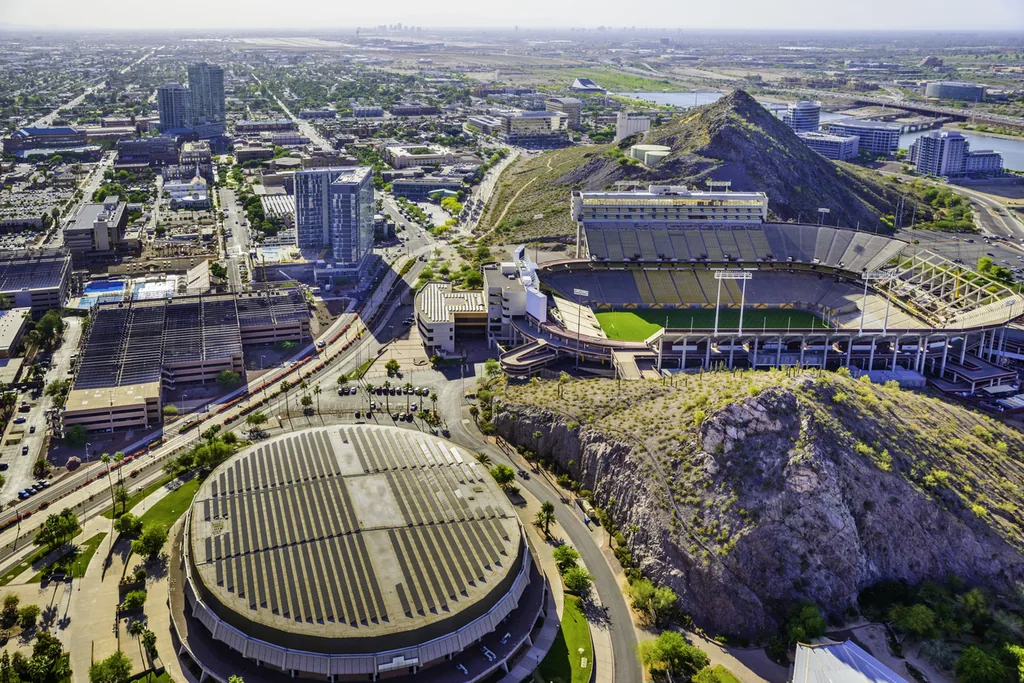
Tempe, AZ Solar Panels

Solar Power in Tempe
Planning solar panel installation in Tempe starts with the details of your home: Arizona sunshine is plentiful, but roof direction, shade, electricity use, and your utility’s rates all affect how a system may work for you.
This guide explains what to expect from solar installation in Tempe, including the local factors that shape system planning. For a helpful starting point, explore our guide to home solar panels.
How Much Do Solar Panels Cost in Tempe, AZ?
Explore solar installation costs in Tempe using estimates grounded in Palmetto’s real Arizona installation data—not generic averages. We draw on projects in Tempe and nearby communities, including Mesa, Chandler, and Scottsdale, to help you understand what solar panels may cost in your area.
System
- No upfront investment
- Palmetto handles all maintenance
- 90% Production Guarantee
- Comprehensive protection program included
Key Takeaways
- Tempe’s sunshine is a strong starting point for solar, but roof direction, shade, household electricity use, and utility rules affect system design and value.
- A medium-home estimate is about $22,405 after an Arizona state incentive; actual costs and savings depend on your home and energy use.
- APS and SRP have different rates and solar export rules, so compare your utility’s terms and seasonal production when planning a system.
Tempe Electricity Prices
What do rising electricity prices mean for Tempe homeowners considering solar?
The chart’s figures show Arizona’s per-kilowatt-hour price rising from 12.5 cents in 2021 to 14.9 cents in 2024, while the U.S. figure rose from 13.7 to 16.5 cents. These are statewide and national figures, not Tempe rates.
A home solar system can generate electricity where it is used, potentially reducing how much power a household buys from its utility. The impact depends on system output, household use, and local utility rules.
Over time, generating some electricity at home may help limit exposure to future grid-price increases. Long-term value varies with installation costs, system performance, utility rates, and how long the system is used.
Price of Energy: Arizona vs National Average
Tempe Area Utility Providers
In Tempe, electricity customers may be served by APS or SRP. The latest figures available here are from 2023: APS averaged 15.3¢ per kWh and SRP 12.5¢.
Arizona’s 2023 average was 14.0¢ per kWh, compared with 16.0¢ nationally. APS was above the state average but below the national figure; SRP was below both. The provided data does not explain why rates differ.
These rates offer Tempe households a useful starting point for considering solar’s potential to offset some grid electricity use. Actual value depends on household energy use and utility terms, so a lower rate alone does not determine whether solar makes sense.
Tempe Utilities Electricity Rates
Arizona Solar Incentives
Tempe homeowners may find Arizona tax, property-value, utility, and battery programs that affect solar costs. Review the solar incentives in Arizona below.
Arizona support can include a state income-tax credit, qualifying solar-equipment sales-tax treatment, and a property-valuation exclusion. Export credits vary by utility and rate plan; eligible APS and TEP customers may also earn seasonal battery rewards.
These Arizona programs may help offset costs, though eligibility and utility rules vary. Reviewing ownership and payment options can clarify how incentives apply to a solar installation in Tempe.
| Incentive | Type | Description | Source |
|---|---|---|---|
| Arizona Credit for Solar Energy Devices (Form 310) | State Income-Tax Credit | Arizona residents may claim a credit of 25% of qualifying solar-device costs, up to $1,000 per residence, with unused credit generally carried forward for up to five consecutive years. | Learn More |
| Arizona Solar-Equipment Transaction Privilege Tax (TPT) Treatment | Sales-Tax Exemption / Deduction | The qualifying retail sale of a solar energy device may be excluded from the applicable Arizona TPT tax base when sold through a properly registered solar-energy retailer. | Learn More |
| Arizona Property Valuation Treatment for On-Site Solar | Property-Tax Valuation Exclusion | Qualifying on-site solar energy equipment is treated as adding no value to the property for appraisal purposes, reducing the risk that the solar system increases assessed property value. | Learn More |
| Arizona Solar Export Compensation and Interconnection Tariffs | Net Billing / Net Metering / Export Compensation | Arizona has no single statewide solar export rate; bill credits and compensation depend on the customer’s utility, rate plan, tariff, and sometimes interconnection history. | Learn More |
An Arizona resident who is not claimed as another taxpayer’s dependent may claim a credit equal to 25% of the cost of a qualifying solar energy device installed at the resident’s Arizona home, up to a maximum of $1,000. The $1,000 limit is cumulative for the same residence, rather than a new limit for each system.
Claim the credit using Arizona Form 310 and Form 301. Unused credit may generally be carried forward for up to five consecutive tax years. A solar system that includes storage may qualify, but a stand-alone battery is not clearly covered; check the current instructions or consult ADOR or a tax professional. See ADOR Form 310 information and A.R.S. § 43-1083.
Arizona law provides favorable TPT treatment for qualifying retail sales of solar energy devices. The practical benefit is potential avoidance of applicable transaction privilege tax on the qualifying equipment purchase; the exact tax treatment depends on the transaction and the retailer’s status.
This is not a blanket exemption for every installation, labor, or contracting charge. Confirm that the seller is registered as required and ask how the exemption is reflected on your invoice. See A.R.S. § 42-5061 and ADOR contracting guidance.
Arizona law provides that qualifying on-site solar equipment is considered to add no value to the property for appraisal purposes. This can help prevent a qualifying solar installation from increasing the property’s assessed value and resulting property-tax valuation.
This is a valuation rule, not a cash rebate or a direct reduction in the home’s existing assessed value. The law covers specified solar devices and grid-tied photovoltaic systems primarily used to produce energy for on-site consumption; do not assume a stand-alone battery receives the same treatment. See A.R.S. § 42-11054.
Tempe homeowners should check SRP’s current tariff before sizing a solar system: export compensation is utility- and plan-specific, and new customers generally should not assume they will receive retail-rate net metering. SRP uses its own price plans, which can include within-billing-cycle netting or fixed export credits.
SRP also has a separate Renewable Export Program for qualifying facilities of 100 kW AC or less. It may offer a capacity credit for customers who enroll under the program and commit to delivering capacity during an eligible period; it is not an automatic credit for every solar customer. Check the current terms, rates, interconnection requirements, and enrollment status directly with your utility: SRP solar plan comparison, and SRP Renewable Export Program.
Ready to start saving with solar?
Speak with a Palmetto solar expert to find out exactly how much you can save with Arizona incentives.
Get a Free QuoteTempe Solar Irradiance
Solar panel production varies throughout the year based on daylight hours, weather patterns, and sun intensity. Understanding how seasons affect your solar system helps set realistic expectations for your investment.
Tempe’s abundant sunshine supports strong solar production, while intense summer heat, monsoon clouds, and seasonal sun angles can affect output. With a well-designed system, solar can perform well year-round.
Solar Production in Tempe by Month
What Can Your Solar System Power?
Summer Production (July)
In July, your 10 kW system could power:
- 3.6 average homes (15 kWh/day per home)
- or Run central AC for 18 hours AND power all other appliances
- or Fully charge 5.4 Tesla Model 3 electric vehicles
Winter Production (December)
In December, your 10 kW system could power:
- 2 average homes (15 kWh/day per home)
- or Keep your home heating system running for 15 hours
- or Fully charge 3 Tesla Model 3 electric vehicles
Annual Production
Over a year, your 10 kW system could:
- Offset 10 tons of carbon dioxide emissions
- or Equal the environmental benefit of planting 175 trees
- or Save approximately $4,234 in electricity costs
Want to know exactly how much solar can power your home?
Get a personalized solar analysis based on your actual home, energy usage, and roof characteristics.
Get My Custom EstimateSolar Panel Systems in Tempe
We’ve organized solar installation data across the U.S. and are excited to share this interactive map of Tempe. Explore the hexagons to see how many installations are in each area and discover the neighborhoods and communities where your neighbors have made the switch to solar.
How to Choose a Solar Installer in Tempe
Verify the license
A contractor doing paid residential solar work in Arizona generally needs an appropriate Arizona contractor license. The license classification depends on the project’s scope, and solar-device installers must meet applicable solar-contractor qualifications. The Arizona Registrar of Contractors (AZ ROC) handles contractor licensing. Ask the installer for its license details, then confirm with the AZ ROC that the license is current and appropriate for the work; no direct lookup page was provided here. You can review the Arizona statute on solar-contractor licensing, but a statute is not a license lookup.
Look for certified installers
NABCEP credentials and manufacturer certifications are additional qualifications to compare, not substitutes for the required Arizona contractor license. Ask which people assigned to your project hold them, what specific credential they have, and whether it relates to the equipment or work in your proposal. You can learn more about NABCEP at NABCEP.org. Compare credentials consistently across bidders, and ask each company who will supervise the installation.
Compare quotes the same way
Request written proposals with the same assumptions, then compare line by line. A lower monthly payment may reflect different terms or equipment, so look at the full price and contract as well.
- System size: Compare the proposed capacity in kilowatts (kW).
- Price: Ask for total cost and price per watt, and compare cash purchase and financing terms on the same basis.
- Equipment: Record panel and inverter brands and models.
- Production: Compare the estimated annual output in kilowatt-hours (kWh/year); ask what assumptions the estimate uses.
- Warranties: Check panel product and performance, inverter, workmanship, and roof-penetration coverage, including who handles a claim.
- Responsibilities and payment: Confirm who handles permits and utility interconnection, the total cost or monthly payment, and whether payments have an escalator.
Permits, interconnection and your HOA
Building and electrical permits and inspections are handled by the local authority having jurisdiction; the correct office and requirements depend on your property address. The homeowner or installer applies to the serving electric utility for interconnection and an agreement. Confirm which utility serves your address; Arizona providers include Arizona Public Service Co, Salt River Project, Tucson Electric Power Co, and UNS Electric, Inc. For utilities under Arizona Corporation Commission jurisdiction, an interconnection agreement is required before connecting; municipal electric systems are not under ACC jurisdiction and may have different requirements.
Arizona law limits HOA and covenant restrictions on rooftop solar. Planned-community associations cannot prohibit solar devices and may impose only reasonable placement rules that do not prevent installation or impair function, use, cost, or efficiency. Effectively prohibiting covenants are generally unenforceable, with an exception for instruments entered into before April 17, 1980. These protections do not create an easement over neighboring property. See A.R.S. §§ 33-1816 and 33-439.
Red flags
- Pressure to sign the same day, before you can compare proposals or review terms.
- An unlicensed crew, or out-of-state crews without a clear Arizona-licensed contractor responsible for the work.
- A vague production estimate with no annual kWh figure or explanation.
- A large upfront deposit without a clear written schedule of payments and milestones.
- A promise of homeowner federal tax credits for a 2026 purchase; those credits ended December 31, 2025.
Leasing Solar Panels
Solar leasing is available in Tempe for customers served by Arizona Public Service (APS) or Salt River Project (SRP). Palmetto’s Arizona options list leases, not power purchase agreements (PPAs); availability can depend on your address and utility.
With a lease, you pay a set monthly amount rather than buying the system upfront. The leasing company owns the panels and handles system maintenance under the agreement. By comparison, a cash buyer owns the system and is responsible for arranging maintenance.
Lease payments are generally fixed, while PPA payments are based on the electricity the system produces; PPAs are not listed as an available Palmetto option in Arizona. Read more about buying or leasing solar and LightReach.
Go solar without the investment
With LightReach, there are no investment costs to recoup, loan payments to manage, or maintenance needs to take on. As soon as your panels are active, your solar savings are too!
Explore LightReach LeasingFrequently Asked Questions
Tempe does not have one citywide net metering policy. Most residents are served by APS or SRP, which compensate solar exports through utility-specific net billing rather than a simple one-for-one retail credit.
With SRP, leftover credits can roll over as dollar credits, with value varying by season and rate plan. APS credits exported power at its set export rate. Check your utility and current rate plan, since these terms affect how much your solar system’s excess electricity is worth.
Solar panels may increase a Tempe home’s resale value when the homeowner owns the system. A Zillow study found homes with solar sold for about 4.1% more on average, but that national finding is not a guaranteed increase for every home.
This potential value applies to purchased systems, not leased or third-party-owned (TPO) systems. A lease may affect resale differently because a buyer may need to assume its agreement. Arizona’s property-tax valuation exclusion is separate from market resale value.
In Tempe, LightReach solar leasing has no upfront cost and a low, fixed monthly payment. The calculator above estimates $105 per month for a typical 2,000–3,000-square-foot home; estimates vary by home size.
For a cash purchase, the calculator estimates $22,405 after an Arizona state incentive for an 8.2-kW system. The federal 30% tax credit is no longer available for residential cash purchases following the 2025 federal law change. Actual pricing depends on your home and energy use.
With Palmetto’s LightReach lease, Palmetto owns the system and you pay a set monthly amount. In Tempe, an 8.20 kW system is estimated at $105/month, using Arizona’s 1,624 kWh/kW/year production ratio and a $0.095/kWh rate.
There’s no upfront cost. The payment includes panels, installation, monitoring, maintenance, and comprehensive protection with a 90% Production Guarantee. It’s typically less than your current electricity bill, so savings may start day one; actual bills depend on usage and APS or SRP rates.
A typical 8.2 kW solar system in Tempe can produce about 14,300 kWh per year, based on the article’s NREL PVWatts estimate of 17,454 kWh annually for a 10 kW system, scaled to 8.2 kW.
Actual production varies with roof direction and condition, shading, system design, and weather. Output also changes by season: Tempe’s summer heat and monsoon clouds, as well as shorter winter days, can affect monthly generation.
Solar panels in Tempe are generally low maintenance. Dust and debris can collect on panels, so occasional cleaning may be needed; monitoring system output can help spot performance issues.
With LightReach, Palmetto owns the system and handles maintenance, monitoring, and repairs at no extra cost. The service also includes a 90% Production Guarantee.
Solar can be worth it financially in Tempe when the electricity your panels produce helps lower your overall energy costs. With a LightReach lease, there’s no upfront investment, and the monthly payment is typically less than your current electricity bill, so savings can begin once the system is active.
Your actual savings depend on your APS or SRP plan, household energy use, roof conditions, and any remaining utility charges. Compare the lease payment plus your new utility bill with what you pay today.