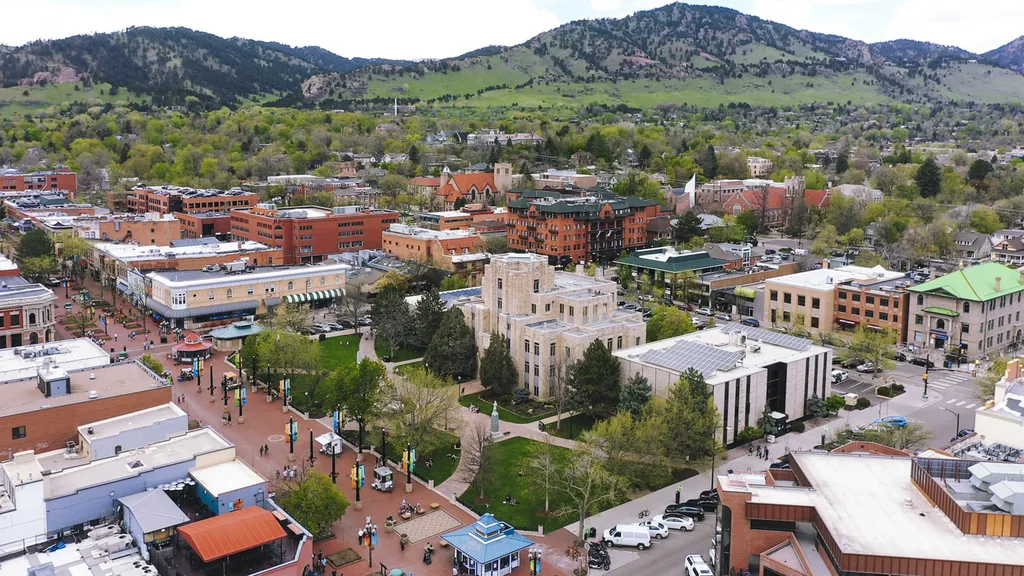
Boulder, CO Solar Panels
In This Guide

Solar Power in Boulder
Planning solar installation in Boulder, CO? Your roof’s sun exposure, seasonal shading, and household electricity use all help determine what a solar panel system can produce. Local permitting and utility interconnection requirements are also part of planning an installation.
Explore the steps, equipment, and questions to consider before getting started. Our guide to home solar panels explains the basics in clear, practical terms.
How Much Do Solar Panels Cost in Boulder, CO?
Explore an estimate for solar installation in Boulder using Palmetto’s data from completed installations in the area. Local pricing insights reflect projects in Boulder and nearby communities, including Longmont, Louisville, Lafayette, and Superior, helping you understand what solar may cost for your home.
System
- No upfront investment
- Palmetto handles all maintenance
- 90% Production Guarantee
- Comprehensive protection program included
Key Takeaways
- Boulder solar output depends on your home Roof sun exposure, shade, household electricity use, and seasonal daylight all affect production.
- Local cost estimates offer a starting point For a 6.56-kW cash system, the calculator estimates $19,534 upfront and about $53,057 in 25-year savings.
- Boulder offers local solar incentives These include an approximately 15% rebate on eligible city sales and use tax; program eligibility and funding can change.
Boulder Electricity Prices
Electricity costs can shape the value of solar, but Colorado’s rates are not the same as Boulder’s.
The chart shows Colorado’s average residential rate rising from 13.1 cents per kilowatt-hour in 2021 to 15.1 cents in 2024. The U.S. average increased from 13.7 to 16.5 cents over the same period.
For Boulder households, rooftop solar can generate electricity at home and offset some power bought from the grid. How much it offsets depends on system size, roof conditions, household use, and utility rules.
Over time, solar may help limit exposure to changing electricity prices by supplying some of a home’s power. Long-term value depends on installation costs, system output, utility rates, and how long the system operates.
Price of Energy: Colorado vs National Average
Boulder Area Utility Providers
In Boulder, CO, Xcel Energy is the utility listed for this comparison. The latest available figures are from 2023, when its average electricity rate was 14.3¢ per kilowatt-hour (kWh).
Xcel’s 2023 rate matched Colorado’s 14.30¢/kWh state average and was below the national average of 16.0¢/kWh. These figures show how rates compare; they do not explain why they differ.
For Boulder households, solar can generate some electricity on-site and may reduce how much power they buy from the grid. Its value depends on household use and system production, while grid rates can change over time.
Boulder Utilities Electricity Rates
Colorado Solar Incentives
Boulder-area homeowners may find state and local incentives that help offset solar costs. See the solar incentives in Colorado listed below.
Colorado exempts qualifying, independently owned residential solar systems from property tax when they do not produce income. Boulder also rebates about 15% of city sales and use tax on eligible solar materials, permits, and permanently installed batteries.
Utility solar and battery incentives vary by provider and service territory. With LightReach leasing, Palmetto handles the commercial ITC, passing savings through as lower monthly payments.
| Incentive | Type | Description | Source |
|---|---|---|---|
| Colorado Residential Solar Property-Tax Exemption | Property Tax Exemption | Colorado law exempts qualifying independently owned residential solar-electric generation facilities from property tax when they are not used to produce income. | Learn More |
| Xcel Energy Renewable Battery Connect | Utility Battery Rebate and Participation Payment | Xcel Energy offers upfront incentives for eligible batteries enrolled in grid-demand events, with higher per-kW amounts for qualifying income-qualified and disproportionately impacted community customers. | Learn More |
| Xcel Energy Solar*Rewards Income-Qualified On-Site Solar | Utility Solar Rebate | Xcel’s posted income-qualified residential solar guidance lists an incentive of $1 per watt for systems up to 7 kW, subject to current program terms and funding. | Learn More |
| City of Boulder Solar and Battery System Tax Rebate | Local Sales and Use Tax Rebate | Boulder residents and businesses may receive a rebate of approximately 15% of City of Boulder sales and use tax paid on eligible solar materials, permits, and qualifying permanently installed batteries. | Learn More |
Colorado law provides a property-tax exemption for an independently owned residential solar-electric generation facility that is not used to produce income. This can prevent qualifying residential solar equipment from increasing the property-tax assessment, but it is not a cash payment or a reduction in the system’s purchase price.
The exemption depends on ownership and use of the facility. The statute also provides that qualifying rebates, offsets, credits, and reimbursements are not treated as income for this exemption. Homeowners should confirm how the local assessor applies the statute to their equipment and ownership arrangement.
Xcel’s Renewable Battery Connect offers a standard upfront incentive of $250 per kW AC of maximum continuous discharge power, capped at $5,000 per application. The listed higher tiers are $1,000 per kW AC for income-qualified customers and $500 per kW AC for customers in disproportionately impacted communities; each higher-tier incentive is capped at 75% of eligible equipment-only cost. Participating customer types may also receive $100 per year for five years for taking part in control events.
The battery must meet Xcel’s equipment and enrollment requirements and be available for utility management during grid-demand events; eligible equipment lists include specified Tesla Powerwall and Enphase models. The 2026 program reopened May 21, and Xcel’s posted budget information was last updated September 1, 2026. Funding can change, so confirm eligibility, remaining funds, and event obligations with Xcel or an authorized installer before committing.
Xcel’s posted income-qualified on-site solar guidance lists an incentive of $1 per watt of installed solar, up to 7 kW. The published eligibility guidance includes households at or below 200% of the federal poverty guideline or 80% of area median income, as well as households qualifying through specified assistance programs. Actual participation depends on the current program offer, application approval, and available funding.
Xcel’s 2026–2027 renewable plan includes targeted income-qualified and disproportionately impacted community solar offerings. A residential incentive-calculation notice posted in September 2026 was still under review as of October 2, 2026, so do not treat a proposed calculation as a finalized rate; confirm the current offer and enrollment status directly with Xcel before signing a solar contract.
The City of Boulder rebate returns approximately 15% of the City sales and use tax paid on eligible solar materials and permits; it is not 15% of the total project price. Since April 2026, the program also covers tax paid on qualifying permanently installed battery systems that operate in parallel with the utility grid.
Boulder residents and businesses may apply within 12 months after the City’s final inspection. The rebate is subject to funding availability, and eligibility depends on the equipment, taxes paid, and city program requirements. Keep itemized invoices and inspection records and review the city’s current application instructions.
Ready to start saving with solar?
Speak with a Palmetto solar expert to find out exactly how much you can save with Colorado incentives.
Get a Free QuoteBoulder Solar Irradiance
Solar panel production varies throughout the year based on daylight hours, weather patterns, and sun intensity. Understanding how seasons affect your solar system helps set realistic expectations for your investment.
Boulder’s high elevation and abundant sunshine support strong solar production, while winter snow and shorter days can reduce output. With the right system, solar can work well year-round.
Solar Production in Boulder by Month
What Can Your Solar System Power?
Summer Production (July)
In July, your 10 kW system could power:
- 3.6 average homes (15 kWh/day per home)
- or Run central AC for 18 hours AND power all other appliances
- or Fully charge 5.4 Tesla Model 3 electric vehicles
Winter Production (December)
In December, your 10 kW system could power:
- 2 average homes (15 kWh/day per home)
- or Keep your home heating system running for 15 hours
- or Fully charge 3 Tesla Model 3 electric vehicles
Annual Production
Over a year, your 10 kW system could:
- Offset 10 tons of carbon dioxide emissions
- or Equal the environmental benefit of planting 175 trees
- or Save approximately $4,234 in electricity costs
Want to know exactly how much solar can power your home?
Get a personalized solar analysis based on your actual home, energy usage, and roof characteristics.
Get My Custom EstimateSolar Panel Systems in Boulder
We’ve organized solar installation data across the United States and are excited to share this interactive map of Boulder. Explore the hexagons to see installation counts and discover how neighborhoods and communities across the area are making the switch to solar.
How to Choose a Solar Installer in Boulder
Verify the license
Colorado does not issue a general, stand-alone state solar-contractor license. For covered photovoltaic and electrical work, the contractor needs state authorization: registration as an electrical contractor or, if eligible, registration as a photovoltaic installer. The limited photovoltaic-installer route has requirements, including performing PV work as of September 1, 2025, good standing and registration with the Secretary of State, employing a NABCEP PV installation professional, and Electrical Board registration by December 31, 2026. For qualifying systems under 300 kW DC, module and mounting-equipment installation must be supervised onsite by a certified photovoltaic energy practitioner working for the contractor. Ask which registration applies and verify it with the Colorado State Electrical Board / DORA Division of Professions and Occupations. The new category’s availability in the public lookup was uncertain as of October 2, 2026, so confirm directly with the Board if a contractor claims that registration. Also check with your city or county about any local contractor requirements.
Look for certified installers
Ask who will perform and supervise the installation, and whether the people doing the work hold NABCEP credentials relevant to the project. NABCEP explains its certifications at nabcep.org. Manufacturer certifications can indicate that an installer has completed a particular manufacturer’s training or approval process; ask which products and people the credential covers. Neither type of credential replaces required state authorization. Compare credentials alongside the company’s written scope, references, and warranty commitments.
Compare quotes the same way
Request comparable written quotes and check that each covers the same home, roof and equipment scope. Compare:
- System size in kW and price per watt.
- Panel and inverter brands and models.
- Estimated production in kWh per year and the assumptions behind it.
- Panel product and performance warranties, inverter warranty, workmanship warranty, and coverage for roof penetrations.
- Who handles permits, inspections, and utility interconnection.
- Total cost or monthly payment, plus any payment escalator and the terms that affect it.
Ask each installer to explain differences in production estimates or exclusions rather than comparing only the headline price.
Permits, interconnection and your HOA
Confirm who obtains approvals before work begins. Building permits and inspections generally go through the local authority; electrical permits and inspections go through the applicable local electrical inspection authority or, where applicable, the State Electrical Board/DORA process. Confirm the right authority for your property address. Utility interconnection is separate from a local building permit: you or the installer applies to the serving utility. Confirm which utility serves your address; names to check include Public Service Co of Colorado, City of Colorado Springs, CORE Electric Cooperative, and United Power. Utilities’ interconnection standards can differ by utility type. Colorado law limits HOA restrictions on renewable-energy devices: an association may not prohibit rooftop solar, though reasonable restrictions may apply (C.R.S. §§ 38-30-168 and 38-33.3-106.5(1.5)). Ask how the installer will address applicable HOA review requirements.
Red flags
- Pressure to sign the same day. Take time to compare written terms.
- Unlicensed or out-of-state crews without a clear, verifiable responsible contractor. Ask who is authorized and who supervises the work.
- Vague production estimates or reluctance to explain assumptions.
- A large upfront deposit without clear written milestones and refund terms.
- Promises of federal homeowner tax credits for purchases in 2026; homeowner credits ended December 31, 2025.
Leasing Solar Panels
For Boulder homeowners served by Xcel Energy, a solar power purchase agreement (PPA) is available through Palmetto, subject to home and utility eligibility. Check current terms for your address.
With a PPA, you pay for the electricity your panels generate at a set price per kilowatt-hour, so payments can change with seasonal production. A lease instead typically has a fixed monthly payment. Learn more about buying versus leasing solar.
Unlike paying cash to own a system, a PPA can avoid the large upfront purchase cost. The provider typically owns and maintains the system under the agreement, reducing maintenance responsibilities for you; review contract terms for details. Palmetto’s LightReach information explains its lease option.
Go solar without the investment
With LightReach, there are no investment costs to recoup, loan payments to manage, or maintenance needs to take on. As soon as your panels are active, your solar savings are too!
Explore LightReach LeasingFrequently Asked Questions
Yes. Boulder homeowners served by Xcel Energy can use net metering. Solar electricity sent to the grid earns credits at a 1:1 rate, and excess credits carry from month to month as dollar credits.
Xcel customers can choose an annual cash-out at the utility’s average incremental cost rate or let credits roll over indefinitely. Rollover credits are not paid out and may be forfeited if you move. Check your utility account, since rules depend on your provider.
Yes, an owned solar panel system may increase a home’s value in Boulder, CO. Zillow’s study found homes with solar panels sold for approximately 4.1% more on average, though that figure is not a guarantee for an individual Boulder home.
This potential value increase applies to systems the homeowner purchased and owns, not leased or third-party-owned (TPO) systems. A leased system may affect resale differently because the buyer may need to assume the lease agreement.
In Boulder, a LightReach lease can provide solar for a low, fixed monthly payment with no upfront cost. The calculator above estimates $77 per month for a typical 2,000–3,000-square-foot home; payment estimates vary by home size and energy use.
As an alternative, the calculator estimates about $19,534 to buy a typical 6.56-kW system with cash. The federal 30% tax credit is no longer available for residential cash purchases following the 2025 federal law change. See the calculator above for estimates by home size.
In Boulder, a typical 6.56 kW solar lease is about $77 per month, estimated using Colorado’s production ratio of 1,346 kWh per kW per year and a rate of $0.105 per kWh. Actual payments vary by home and contract.
With Palmetto’s LightReach lease, there is no upfront cost; one monthly payment covers the system, installation, monitoring, maintenance, and protection program, including a 90% Production Guarantee. Savings may begin right away when the lease payment is lower than your electricity bill.
Solar panels in Boulder are low maintenance. Rain often rinses away dust, though heavy snow or debris can temporarily reduce production; avoid climbing onto the roof to clear panels.
With LightReach, Palmetto owns the system and handles maintenance, monitoring, and repairs at no extra cost. The agreement also includes a 90% Production Guarantee.
Solar can be financially worthwhile in Boulder, depending on your roof, electricity use, utility rates, and contract terms. With a LightReach lease, there is no upfront investment, and the monthly lease payment is typically less than your current electricity bill, so savings can begin once the system is operating.
Compare the lease payment and any remaining utility charges with your current bill. For context, the article estimates about $77 per month for a typical 6.56-kW leased system; actual costs and savings vary by home.
Yes, solar can make sense in Boulder, where abundant sunshine supports year-round production, though winter days and roof shade can reduce output. A typical 6.56-kW system is estimated at about $19,534 upfront, with roughly $53,057 in 25-year savings; actual results depend on your roof, energy use, utility rules, and costs.
Boulder’s eligible solar installations may also qualify for a city sales and use tax rebate. LightReach, Palmetto’s solar lease program, removes the upfront cost barrier entirely: homeowners can go solar with no money down and start saving from day one.