Electric vs. hydronic baseboard heaters: how to tell the difference
Last edited
Author
Andrew Blok
Electrification and Solar Writer and Editor

Electric baseboard heaters can be one of the most expensive ways to heat a home. But not all baseboard heaters are electric. So how do you tell the difference?
If you've moved into a home with baseboard heat and want to understand your system, or just make sense of your bill, here's what you need to know.
See how much you can save with a new HVAC system from Palmetto
Electric vs. hydronic baseboard heat
There are two types of baseboard heaters.
Electric baseboard heaters use electric resistance heating. Electricity flows through a metal element inside the unit, the element heats up, and that heat radiates into the room. You may also hear these called resistance heaters.
Hydronic baseboard heaters use liquid instead of a bare metal element. Hydronic means water-based, and inside these units (sometimes called fluid-filled or liquid-filled baseboard heaters) a sealed reservoir of water or glycol (a type of antifreeze) is warmed and circulated through the home. That liquid holds heat longer than a metal element does, so hydronic units tend to cycle on and off less often and distribute heat more evenly.
Both types are common in homes without ductwork: older houses, additions, and multi-unit buildings.
How they compare
Electric resistance heaters warm up quickly and respond almost immediately when you raise the thermostat, but they draw power in short, intense bursts. Hydronic heaters take longer to warm up and stay warm longer after shutting off, which can make the heat feel more consistent. In some conditions, that retained heat means hydronic units use somewhat less energy over a heating season, though both types can be relatively expensive to operate compared to other heating systems.
One other difference: electric resistance heaters tend to tick or click as the metal element expands and contracts. Hydronic units are generally quieter, but will still make noise.
| Feature | Electric resistance | Hydronic (fluid-filled) |
|---|---|---|
| Heat-up speed | Fast | Slower |
| Heat retention after shutting off | Low | Higher |
| Noise | Ticking or clicking common | Generally quieter, but clicks and pops common. |
| Energy source | Electricity only | Electricity, gas, or oil |
| Relative operating cost | High | Varies by energy source |
See how much you can save with a new HVAC system from Palmetto
Is my baseboard heating electric or gas?
Check for a boiler. In homes with a boiler, gas (or oil) heats a fluid that circulates through hydronic baseboard units throughout the house. If your home has a boiler, check what fuel it runs on before assuming your baseboard heat is electric.
Check the unit itself. A standard electric resistance heater typically has metal fins inside, often visible through the front grille. A hydronic unit will show the pipe through which the heated fluid runs, even if it’s within metal fins.
Check your circuit breaker. Baseboard heaters are usually on dedicated circuits. Look for breakers labeled "baseboard" or "heating."
If you're still unsure, an HVAC technician can identify the system in a few minutes.
How baseboard heat compares to a heat pump
Electric baseboard heaters (whether standard resistance or electric hydronic) tend to be among the more expensive ways to heat a home. If you've been trying to understand why your electric bill runs high, the heating system is often a big part of the answer. (More than 50% of the average home’s energy use goes to heating and cooling it.)
A heat pump works differently. Because it moves heat rather than creating it, a heat pump can deliver two to four times more heating energy per unit of electricity than resistance heating. It can also cool your home in summer, which baseboard heaters can't.
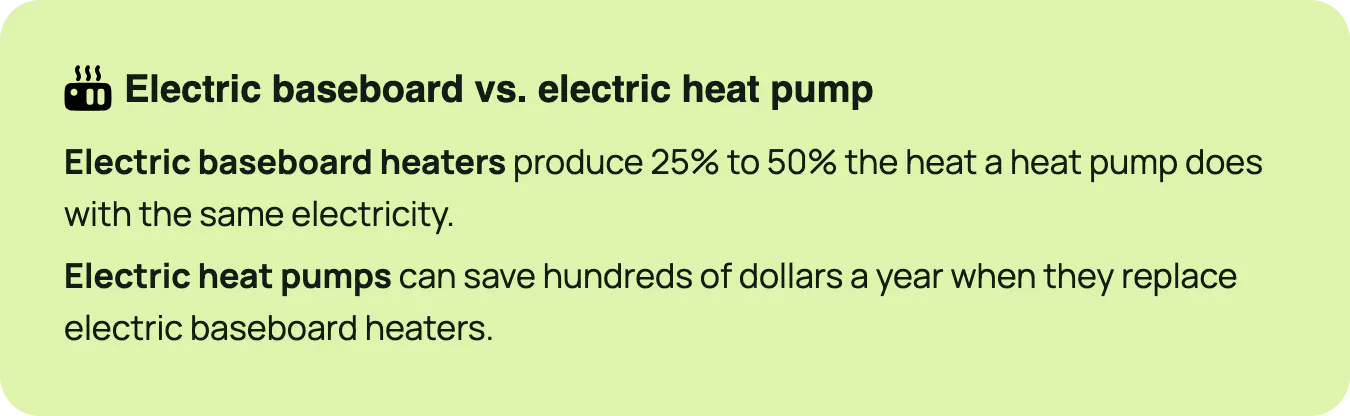
For spaces without ductwork, a ductless mini-split heat pump can be a direct and efficient replacement for baseboard heat in that zone. And if the upfront cost of any HVAC system is a concern, Palmetto's Comfort Plan lets you lease one instead of purchase it. If you’re looking for a new HVAC system, it’s best to get multiple quotes. Get one from Palmetto today.
See how much you can save with a new HVAC system from Palmetto
Frequently asked questions
How do I tell if my baseboard heater is electric or gas?
Start by checking whether your home has a boiler. If it does, and it runs on gas or oil, your baseboard heat is probably gas-sourced. If there's no boiler, check your electrical panel for dedicated breakers labeled "baseboard" or "heating." That's a strong sign the system is electric. An HVAC technician can confirm quickly if you're unsure.
What is a hydronic baseboard heater?
A hydronic baseboard heater uses a sealed reservoir of liquid (water or glycol) instead of a bare metal heating element. That liquid is warmed by a heat source (electricity, gas, or oil) and releases heat slowly and evenly. These units are sometimes called fluid-filled or liquid-filled baseboard heaters.
Are hydronic baseboard heaters more efficient than standard electric ones?
They can be. Because they retain heat longer, hydronic units may cycle on and off less frequently, reducing energy use somewhat. Compared to both options, a heat pump is more efficient.
Can I replace baseboard heaters with a heat pump?
Yes. A ductless mini-split heat pump is a common replacement for baseboard heating in individual rooms or zones, and it heats and cools more efficiently than electric resistance heat. Whether it makes sense depends on your climate, current system, and energy costs.
Why is my baseboard heat so expensive to run?
Electric resistance heating converts electricity to heat at roughly a 1:1 ratio. Heat pumps move existing heat rather than generate it, making them significantly more efficient. Thermostat settings can help at the margins, but the system type is usually the bigger cost driver.
Disclaimer: This content is for educational purposes only. Palmetto does not provide tax, legal, or accounting advice. Please consult your own tax, legal, and accounting advisors.