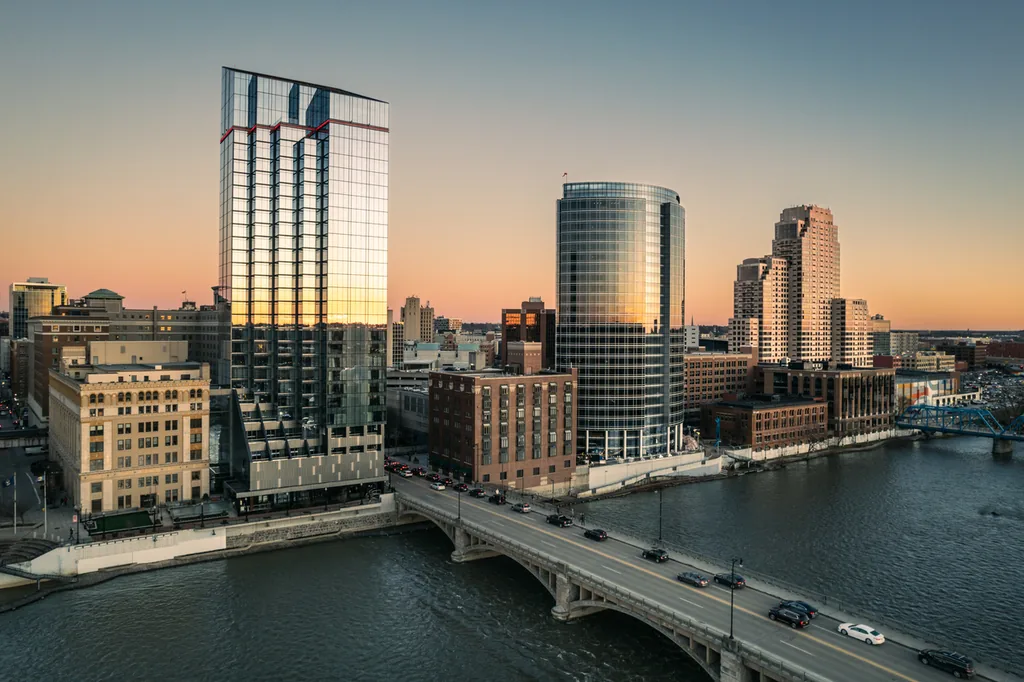
Grand Rapids, MI Solar Panels
In This Guide
- 01 Solar Energy in Grand Rapids
- 02 Solar Cost Calculator
- 03 Grand Rapids Reviews
- 04 Key Takeaways
- 05 Grand Rapids Electricity Prices
- 06 Michigan Solar Incentives
- 07 Grand Rapids Solar Production
- 08 Solar Installations in Grand Rapids
- 09 Choosing an Installer
- 10 Leasing Solar Panels
- 11 Frequently Asked Questions

Solar Power in Grand Rapids
Exploring solar panel installation in Grand Rapids? Michigan’s residential electricity rate is 19.29 cents per kilowatt-hour, so understanding your home’s energy use can help you evaluate whether solar fits your needs.
Roof direction, shade from nearby trees, and seasonal energy use all shape a system’s design. Start with our guide to home solar panels, then learn how these factors apply to homes in Grand Rapids.
How Much Do Solar Panels Cost in Grand Rapids, MI?
Estimate solar installation costs in Grand Rapids using Palmetto’s firsthand data from real Michigan installations. See how local pricing compares across nearby communities, including Wyoming, Kentwood, and Grandville, for a clearer picture of what a solar project may cost in your area.
System
- No upfront investment
- Palmetto handles all maintenance
- 90% Production Guarantee
- Comprehensive protection program included
Key Takeaways
- Solar can work in Grand Rapids year-round, though winter clouds and snow can reduce output while longer summer days boost it.
- Costs and savings depend on your home; one 6.8-kW example estimates $21,521 upfront and about $42,362 in 25-year savings.
- Solar value varies with local conditions: roof direction, shade, energy use, utility rules, and financing options all matter.
Grand Rapids Electricity Prices
For Grand Rapids households, Michigan’s rising electricity rates make it worth understanding how utility costs may shape energy choices.
From 2021 to 2024, Michigan’s average residential rate climbed from 17.5¢ to 19.3¢ per kWh; the U.S. average rose from 13.7¢ to 16.5¢. These statewide figures provide context, not a Grand Rapids-specific rate.
A home solar system can generate electricity where it’s used, potentially reducing how much power a household needs to buy from its utility. Actual savings depend on system design, usage, and utility rules.
Over time, producing some electricity at home may help households manage exposure to changing utility rates and reduce grid purchases. The long-term value depends on system costs, production, household use, and utility rates.
Price of Energy: Michigan vs National Average
Grand Rapids Area Utility Providers
In Grand Rapids, 2023 electricity rates were 18.8¢ per kWh from Consumers Energy and 17.7¢ from Great Lakes Energy. These are the latest utility figures available; 2024 data is not yet available.
Consumers Energy matched Michigan’s 2023 average of 18.80¢ per kWh, while Great Lakes Energy was 1.1¢ lower. Both were above the 16.0¢ national average: by 2.8¢ and 1.7¢, respectively.
With both rates above the national average, solar-generated electricity may offset electricity purchased at those rates. The potential value depends on a home’s energy use and system, so comparing household bills with solar production estimates can help.
Grand Rapids Utilities Electricity Rates
Michigan Solar Incentives
Grand Rapids homeowners can explore financing options that may help manage solar installation costs. See the solar incentives in Michigan table for details.
Michigan Saves offers financing through authorized contractors and participating lenders for eligible solar PV and whole-home battery projects. It is a loan, not a rebate or grant.
With LightReach leasing, Palmetto handles the commercial ITC and passes savings through as lower monthly payments, simplifying how incentives affect costs.
| Incentive | Type | Description | Source |
|---|---|---|---|
| Michigan Saves Residential Solar and Battery Financing | Financing | Michigan Saves offers financing through authorized contractors and participating lenders for eligible solar PV and whole-home battery projects; it is a loan, not a rebate or grant. |
Michigan Saves financing can help eligible homeowners pay for solar PV or whole-home battery storage through an authorized contractor and participating lender. The benefit is access to financing for an eligible project; loan amounts, interest rates, terms, approval, and availability depend on the lender and borrower.
This program does not reduce the project price like a rebate and does not guarantee approval or a particular rate. Confirm current loan terms and that the proposed solar or battery work qualifies before signing a contract.
Ready to start saving with solar?
Speak with a Palmetto solar expert to find out exactly how much you can save with Michigan incentives.
Get a Free QuoteGrand Rapids Solar Irradiance
Solar panel production varies throughout the year based on daylight hours, weather patterns, and sun intensity. Understanding how seasons affect your solar system helps set realistic expectations for your investment.
Grand Rapids’ cloudy winters and snow can lower solar output, while long summer days boost it. Despite local weather anecdotes, a well-designed system can make solar practical year-round.
Solar Production in Grand Rapids by Month
What Can Your Solar System Power?
Summer Production (July)
In July, your 10 kW system could power:
- 3.6 average homes (15 kWh/day per home)
- or Run central AC for 18 hours AND power all other appliances
- or Fully charge 5.4 Tesla Model 3 electric vehicles
Winter Production (December)
In December, your 10 kW system could power:
- 2 average homes (15 kWh/day per home)
- or Keep your home heating system running for 15 hours
- or Fully charge 3 Tesla Model 3 electric vehicles
Annual Production
Over a year, your 10 kW system could:
- Offset 10 tons of carbon dioxide emissions
- or Equal the environmental benefit of planting 175 trees
- or Save approximately $4,234 in electricity costs
Want to know exactly how much solar can power your home?
Get a personalized solar analysis based on your actual home, energy usage, and roof characteristics.
Get My Custom EstimateSolar Panel Systems in Grand Rapids
We’ve organized solar installation data from across the country and are excited to share this interactive map of Grand Rapids. Click a hexagon to see installations in that area and explore the neighborhoods and communities where your neighbors have made the switch to solar.
How to Choose a Solar Installer in Grand Rapids
Verify the license
Michigan does not identify a separate state solar-installer license. Electrical work generally requires a permit, and the permit applicant generally must be an electrical contractor or specialty contractor licensed by the state or municipality. An electrical contractor doing business as an electrician must hold the contractor license and have an associated master electrician. Whether a rooftop-solar job also requires a residential-builder or maintenance-and-alteration license depends on its scope, so ask the installer which licenses apply to your specific project.
Use the Michigan Department of Licensing and Regulatory Affairs (LARA), Bureau of Construction Codes (BCC) entry page to find “Verify a License” and check the company and relevant license holders. Detroit issues its own electrical licenses and registrations, so confirm local requirements there if the property is in Detroit.
Look for certified installers
Ask whether the people designing and installing your system hold relevant NABCEP certifications, and what each credential covers. Certification can help you assess an individual’s training or demonstrated knowledge; it is not a substitute for required licenses, permits, or a review of the contract. Ask for the exact credential and who on the project holds it. Also ask whether the installer or crew is certified by the proposed panel and inverter manufacturers, what that certification covers, and whether it affects equipment support or warranty service. Compare the answers rather than treating a certification logo as a guarantee.
Compare quotes the same way
Request itemized proposals with the same assumptions. Compare:
- System size in kW and quoted price per watt.
- Panel and inverter brands and models.
- Estimated production in kWh per year, plus the assumptions behind each estimate.
- Panel product and performance warranties, inverter warranty, workmanship coverage, and roof-penetration coverage; note who provides each warranty.
- Who applies for permits and handles utility interconnection.
- Total cost or monthly payment, including any escalator, and how the payment may change over time.
Check that the equipment, system size, and payment terms match across proposals before comparing totals.
Permits, interconnection and your HOA
The enforcing agency for building and electrical codes depends on your property address and may be local, county, or state. Electrical work generally requires a permit; ask the appropriate authority whether your particular rooftop project needs a building permit, and get clear on who will apply. The homeowner or installer applies for interconnection through the serving utility. Depending on your location, that may be DTE Electric Company, Consumers Energy Co – (MI), Great Lakes Energy Coop, or Indiana Michigan Power Co. For MPSC-regulated utilities, utility procedures apply and the system may not operate in parallel with the grid until utility approval; municipal electric customers should check directly with their utility. For HOA properties, Michigan’s Homeowners’ Energy Policy Act limits bans on solar installations on a member’s home or unit. HOAs must have a solar policy and cannot prohibit installation on a roof face, though application processes and certain standards are allowed. See MCL 559.307 and 559.309.
Red flags
- Pressure to sign the same day or before you have time to compare terms.
- Unlicensed or out-of-state crews, or reluctance to identify the licensed contractor responsible for the work.
- Vague production estimates without a clear annual kWh figure and assumptions.
- A large upfront deposit without a clear written schedule of work and payments.
- Promises of federal tax credits for homeowner purchases in 2026; homeowner credits ended December 31, 2025.
If licensing, permit, or code concerns arise, LARA BCC Enforcement handles complaints about licensed contractors and code or licensing issues, while the Michigan Attorney General’s Consumer Protection Team accepts general consumer and sales-practices complaints. Contract, monetary, and warranty disputes are outside BCC Enforcement’s scope. See Michigan’s complaint guidance.
Leasing Solar Panels
For Grand Rapids homes served by Consumers Energy, Palmetto LightReach offers a solar power purchase agreement (PPA). DTE Energy customers may also have PPA access; LightReach is not available through Indiana Michigan Power or Lansing Board of Water & Light.
With a PPA, you pay for the electricity your panels produce at an agreed price per kilowatt-hour, rather than a fixed monthly lease amount. Payments can vary by season as production changes. Learn more about buying or leasing solar and how a PPA differs.
Unlike a cash purchase, a PPA does not require you to pay the full system cost upfront. The system provider owns and maintains the panels, helping you avoid taking on maintenance yourself. See LightReach details and review contract terms to understand your responsibilities.
Go solar without the investment
With LightReach, there are no investment costs to recoup, loan payments to manage, or maintenance needs to take on. As soon as your panels are active, your solar savings are too!
Explore LightReach LeasingFrequently Asked Questions
Grand Rapids has net billing for solar, rather than traditional 1:1 net metering. Consumers Energy customers receive credits for electricity their panels send to the grid, generally at a rate below the full retail price. The credit varies by season and time of day, with summer afternoon exports valued highest.
Unused export credits can roll over as a dollar amount to help pay future supply charges. Utility service areas vary around Grand Rapids, so check your electric bill to confirm your provider and its current solar credit rules.
Yes, a purchased or fully owned solar system may increase a Grand Rapids home’s value. A Zillow study found homes with solar panels sold for about 4.1% more, but this national finding is not a guaranteed premium locally. Value can depend on system condition, production, roof, and buyer demand.
This potential value applies to owned panels, not leased or third-party-owned (TPO) systems. With a lease or PPA, resale may work differently because a buyer may need to assume the agreement.
In Grand Rapids, Palmetto’s LightReach option lets homeowners go solar with no upfront cost and a low fixed monthly payment. The calculator above estimates $59–$102 per month depending on home size, or about $78 per month for a medium home.
As a cash alternative, the calculator estimates $16,912–$27,506 before any applicable costs, with a medium-home example of $21,521. The federal 30% tax credit is no longer available for residential cash purchases following the 2025 federal law change. Use the calculator above for home-specific pricing.
Solar leasing lets you use a system without buying it upfront. In Grand Rapids, a typical 6.80 kW system is estimated at $78 per month, based on Michigan’s 1,100 kWh/kW annual production ratio and $0.125/kWh rate.
Palmetto LightReach includes installation, monitoring, maintenance, and a protection program with a 90% production guarantee. The system owner handles maintenance. Grand Rapids agreements may be structured as a PPA, with payments tied to seasonal production, so check the contract; savings depend on whether payments are below your current electric costs.
Yes. Solar panels work in Grand Rapids, which averages about 4.3 peak sun hours per day. They can still generate electricity on cloudy days using available daylight, though output is lower than in direct sun.
Production changes by season: long summer days boost generation, while shorter, cloudier winter days and snow can reduce it. A system’s total yearly output reflects these seasonal ups and downs.
Palmetto Solar is a solar installation option for Grand Rapids homeowners, backed by a national service network and local experience. We have completed 1,591 installations in Michigan since 2020.
The right installer depends on your roof, shade, electricity use, and utility rules. Compare system design, installation support, contract terms, and financing; Palmetto offers multiple financing options to consider.
Solar can make sense in Grand Rapids because Michigan averages 4.3 peak sun hours per day, and local utility rates make generating some electricity at home worth considering. Output is seasonal: cloudy winter weather and snow can reduce production, while longer summer days increase it. Roof direction, shade, energy use, and utility rules affect results.
For example, the article estimates a 6.8-kW system could save about $42,362 over 25 years, with a 14.7-year payback for a cash purchase; actual results vary. LightReach, Palmetto’s solar lease program, removes the upfront cost barrier entirely, so homeowners can go solar with no money down and start saving from day one.