How Mini-Split Heat Pump Sizing Works
Last edited
Author
Andrew Blok
Electrification and Solar Writer and Editor
If you're getting a mini-split heat pump installed, you've probably seen units described in BTUs — 9,000, 12,000, 18,000, 24,000. That’s an important number, but it’s not immediately clear what that means to those of us who aren’t HVAC professionals.
Here's what those numbers mean, what goes into choosing the right one, and how properly sizing a mini-split heat pump is key to getting the best comfort experience.
See how much you can save with a new HVAC system from Palmetto
What is mini-split heat pump sizing?
Sizing means selecting a unit with the right heating and cooling capacity for the space it serves. Too small, and it can't keep up. Too large, and you run into a different set of problems.
Capacity is measured in BTUs — British Thermal Units — which describe how much heat a system can move per hour. You'll also hear capacity described in tons: one ton equals 12,000 BTUs per hour. So a 2-ton mini-split and a 24,000 BTU mini-split are the same thing.
What affects mini-split sizing?
Several factors interact to determine how much capacity a space actually needs.
Square footage is the starting point, but not the whole picture. A rough rule of thumb — around 20–25 BTUs per square foot — gives you a ballpark, but real homes vary too much for a single formula to be reliable.
| Square footage | Rule-of-thumb BTU range | Approximate tonnage |
|---|---|---|
| 400–500 sq ft | 9,000–12,000 BTU | 0.75–1 ton |
| 600–800 sq ft | 12,000–18,000 BTU | 1–1.5 ton |
| 900–1,200 sq ft | 18,000–24,000 BTU | 1.5–2 ton |
| 1,200–1,500 sq ft | 24,000–30,000 BTU | 2–2.5 ton |
These ranges are a general starting point only. Actual sizing depends on your climate, insulation, windows, ceiling height, and other factors. A proper room by room load calculation will often produce different numbers.
Climate zone has a significant effect, particularly for heating. A home in Minnesota is designed for much colder outdoor temperatures than one in Georgia, and a system sized for a mild climate may not work as a cold-climate mini-split.
Insulation and air sealing determine how quickly a space gains or loses heat. A well-insulated room needs less capacity to maintain a comfortable temperature than a drafty one.
Windows and sun exposure can add significant heat load, especially with large south- or west-facing windows. A sunroom and a similarly sized interior bedroom can have very different heating and cooling needs.
Ceiling height matters because you're conditioning a volume of air, not just a floor area. A room with 10-foot ceilings has more air to heat and cool than the same square footage with 8-foot ceilings.
Occupancy and heat-generating appliances also factor in. A home office with multiple monitors or a kitchen with heavy cooking use adds meaningful heat load.
How to size a mini-split heat pump
The industry-standard method is called a Manual J load calculation — a detailed analysis developed by the Air Conditioning Contractors of America (ACCA). A proper Manual J accounts for all the variables above: square footage, ceiling height, insulation, window area and orientation, local climate data, and more.
The output is a precise room by room heating and cooling load for each zone in your home — and where a rule of thumb might point you toward one size, a Manual J often lands somewhere different.
The inputs require accurate measurements and an understanding of your home's construction. Getting one factor wrong — underestimating window heat gain, or using the wrong insulation value — can push the result meaningfully in either direction. A qualified contractor will also factor in how the heat pump performs at low outdoor temperatures, whether it can modulate its capacity, and whether a single-zone or multi-zone setup makes sense.
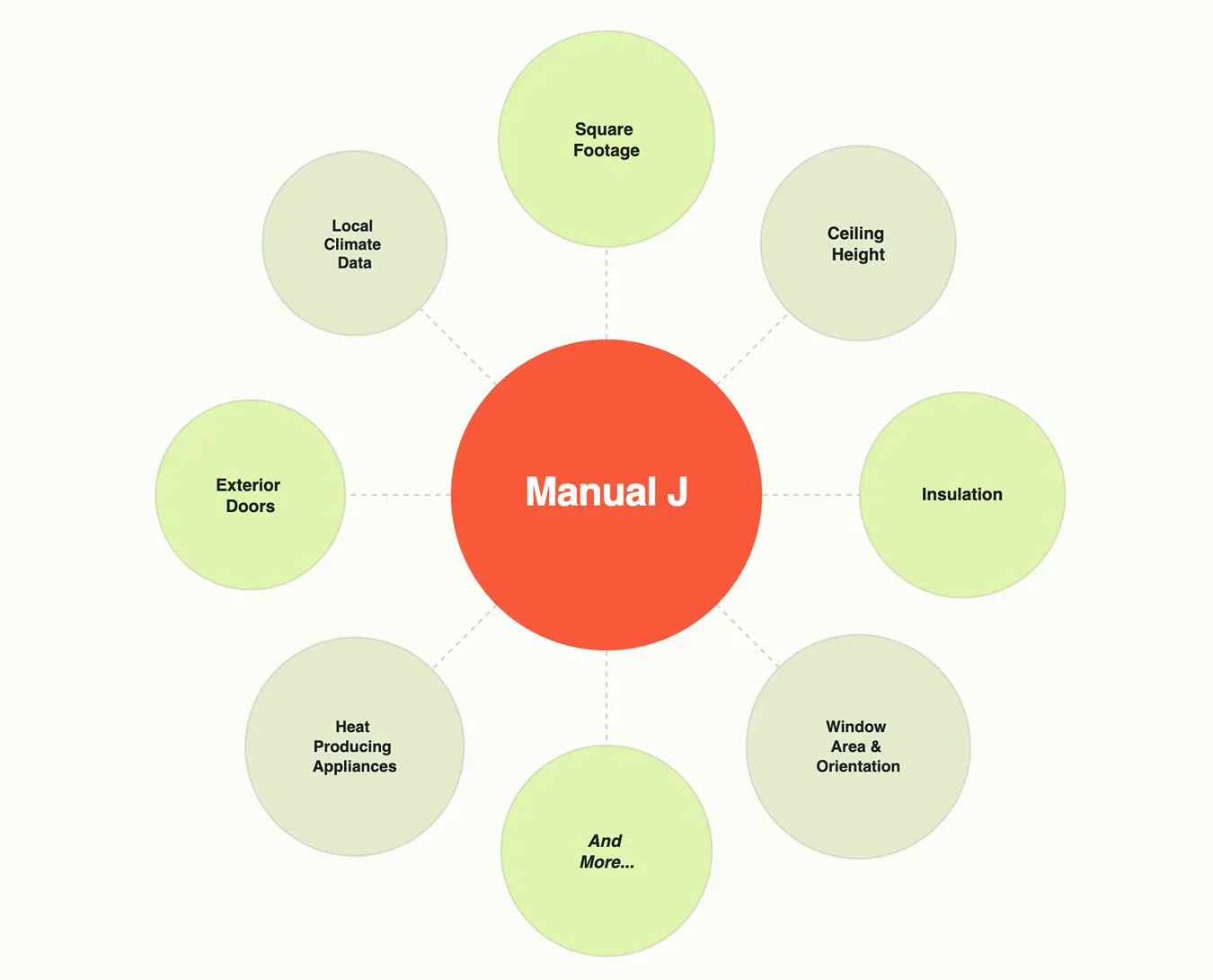
Some of the elements that go into a Manual J calculation.
See how much you can save with a new HVAC system from Palmetto
What happens when a mini-split is the wrong size?
An undersized unit can't reach or hold the temperature you set, especially in extreme weather. It runs continuously, wears down faster, and drives up your energy bill.
An oversized unit is a less obvious problem, but often a bigger one. A system that's too large heats or cools the space quickly, then shuts off — a pattern called short-cycling. Short-cycling increases equipment wear and leads to earlier failures. It also means the unit doesn't run long enough to properly dehumidify the air, which can leave a room feeling clammy even at the right temperature.
Oversizing is a common mistake, partly because it can seem like the safe choice. In HVAC, bigger isn't better — accurate is.
What a good sizing process looks like
The sizing process is a useful signal of contractor quality. A thorough approach typically includes:
A home walkthrough — not just a quick measurement. A good contractor will walk the spaces being conditioned, note window placement, check insulation where possible, and ask how you use the space.
Actual measurements of room dimensions and ceiling heights, rather than estimates or floor plans alone.
A Manual J calculation, or a clear explanation of how they arrived at the capacity recommendation. If a contractor gives you a size without explaining the reasoning, it's fair to ask.
A conversation about your comfort preferences — whether you run warm, whether you want the system to handle very cold winters without backup heat. These can influence where in the calculated range you land.
A clear explanation of the recommended configuration — single-zone vs. multi-zone, where the indoor unit will be mounted, and why. Placement affects airflow and real-world performance.
Palmetto's Comfort Plan connects you with HVAC professionals who can assess your home and recommend the right system for it. Get the best matched HVAC system for your home for predictable monthly payments, and zero upfront cost.
See how much you can save with a new HVAC system from Palmetto
Frequently asked questions
How many BTUs do I need for a 1,000-square-foot space?
As a rough starting point, 1,000 square feet might call for somewhere around 18,000–24,000 BTUs — but that range can shift based on your climate, ceiling height, insulation, and windows. A load calculation will give you a more reliable number than any square-footage estimate.
What's the difference between a 1-ton and a 2-ton mini-split?
Tonnage is another way of expressing capacity. One ton equals 12,000 BTUs per hour, so a 2-ton (24,000 BTU) unit can move twice as much heat as a 1-ton (12,000 BTU) unit.
Can I use a mini-split to heat and cool my whole house?
It depends on your home's layout and the system configuration. A multi-zone system — one outdoor unit connected to several indoor units — can handle whole-home conditioning in many cases. Whether it's the right fit depends on square footage, layout, the number of zones needed, and your climate.
Is it better to size up if I'm not sure?
Not necessarily. Oversized mini-splits short-cycle, which reduces dehumidification, increases wear, and can make spaces feel less comfortable despite hitting the target temperature. The goal is an accurate size. A contractor doing a proper load calculation should be able to get you there.
Do mini-split heat pumps qualify for any rebates or tax incentives?
You may find state and local incentives for mini-split heat pumps. Home efficiency rebate programs are operated in several states already.
Disclaimer: This content is for educational purposes only. Palmetto does not provide tax, legal, or accounting advice. Please consult your own tax, legal, and accounting advisors.