Air conditioner BTU: how air conditioner sizing works and why it matters
Last edited
Author
Andrew Blok
Electrification and Solar Writer and Editor
Longer hotter summers have you losing sleep and focus in a too-hot home?
If you're shopping for a new central air conditioner, or trying to figure out why your current one doesn't quite cut it, you might be wondering, “How much air conditioner is enough?” While cooling is always a matter of personal preference, the technical answer comes in BTUs: the standard measure of cooling capacity for air conditioners.
Getting an air conditioner sized correctly matters. Here’s how air conditioner sizing works, why the math involves more than square footage, and what a proper sizing process looks like.
See how much you can save with a new HVAC system from Palmetto
Why does air conditioner sizing matter?
A too-big or too-small air conditioner causes problems either way.
An undersized unit can't keep up on hot days. It runs constantly, struggles to hit your thermostat setting, and wears out faster.
An oversized unit is a less obvious problem, but still an issue. A system that's too large cools the air quickly and shuts off — a pattern called short-cycling. When an air conditioner short-cycles the system doesn’t run long enough to pull humidity out of the air, leaving your home cool but clammy. It also wears the unit down, leading to more frequent costly air conditioner repairs.
How is air conditioner sizing measured?
Cooling capacity is measured in BTUs (British Thermal Units) which describe how much heat a system can remove from your home per hour. You'll also hear capacity described in tons: one ton equals 12,000 BTUs per hour. A 3-ton system and a 36,000 BTU system are the same thing. Residential central air conditioners typically range from 1.5 to 5 tons.
BTU and tonnage equivalents
| Tonnage | BTU/hour | Typical application |
|---|---|---|
| 1.5 tons | 18,000 BTU | Small homes or zones |
| 2 tons | 24,000 BTU | Small to medium homes |
| 2.5 tons | 30,000 BTU | Medium homes |
| 3 tons | 36,000 BTU | Medium to large homes |
| 3.5 tons | 42,000 BTU | Large homes |
| 4 tons | 48,000 BTU | Large homes |
| 5 tons | 60,000 BTU | Large or high-load homes |
Square footage is the starting point (roughly 20 BTUs per square foot) but that number alone can send you in the wrong direction. A 2,000-square-foot home in Phoenix has very different cooling needs than a 2,000-square-foot home in Portland.
BTU estimates by square footage (rough starting point only)
| Home size | Estimated BTU range | Approximate tonnage |
|---|---|---|
| 1,000–1,200 sq ft | 18,000–24,000 BTU | 1.5–2 tons |
| 1,200–1,500 sq ft | 21,000–30,000 BTU | 1.75–2.5 tons |
| 1,500–2,000 sq ft | 24,000–36,000 BTU | 2–3 tons |
| 2,000–2,500 sq ft | 34,000–42,000 BTU | 2.5–3.5 tons |
| 2,500–3,000 sq ft | 40,000–48,000 BTU | 3–4 tons |
| 3,000+ sq ft | 48,000+ BTU | 4+ tons |
Again, these are rough starting points. Your actual load depends on:
Climate: Hot, humid climates require more capacity and put more demand on the system at peak temperatures.
Insulation and air sealing: A well-sealed home holds cool air longer and needs less capacity. A drafty one needs more. Adequate insulation can reduce the size of air conditioner a home needs.
Windows: South- and west-facing windows add significant heat load. A sunroom and a same-sized interior bedroom can have very different cooling needs. Leaky or inefficient windows can add to the required cooling capacity.
Ceiling height: You're conditioning a volume of air, not just a floor area. Higher ceilings mean more to cool.
Occupancy and appliances: A home office with multiple computers or a heavily used kitchen adds heat the system has to remove.
See how much you can save with a new HVAC system from Palmetto
What is SEER2, and why does it matter?
BTU tells you how much cooling a system delivers. SEER2 (Seasonal Energy Efficiency Ratio 2) tells you how efficiently it delivers it. A higher SEER2 rating means less electricity for the same amount of cooling.
(SEER2 is the federal standard that replaced the older SEER metric in January 2023. The new testing method is more realistic, so SEER2 ratings run slightly lower than equivalent SEER ratings on the same equipment. When comparing systems, make sure you're comparing the same metric.)
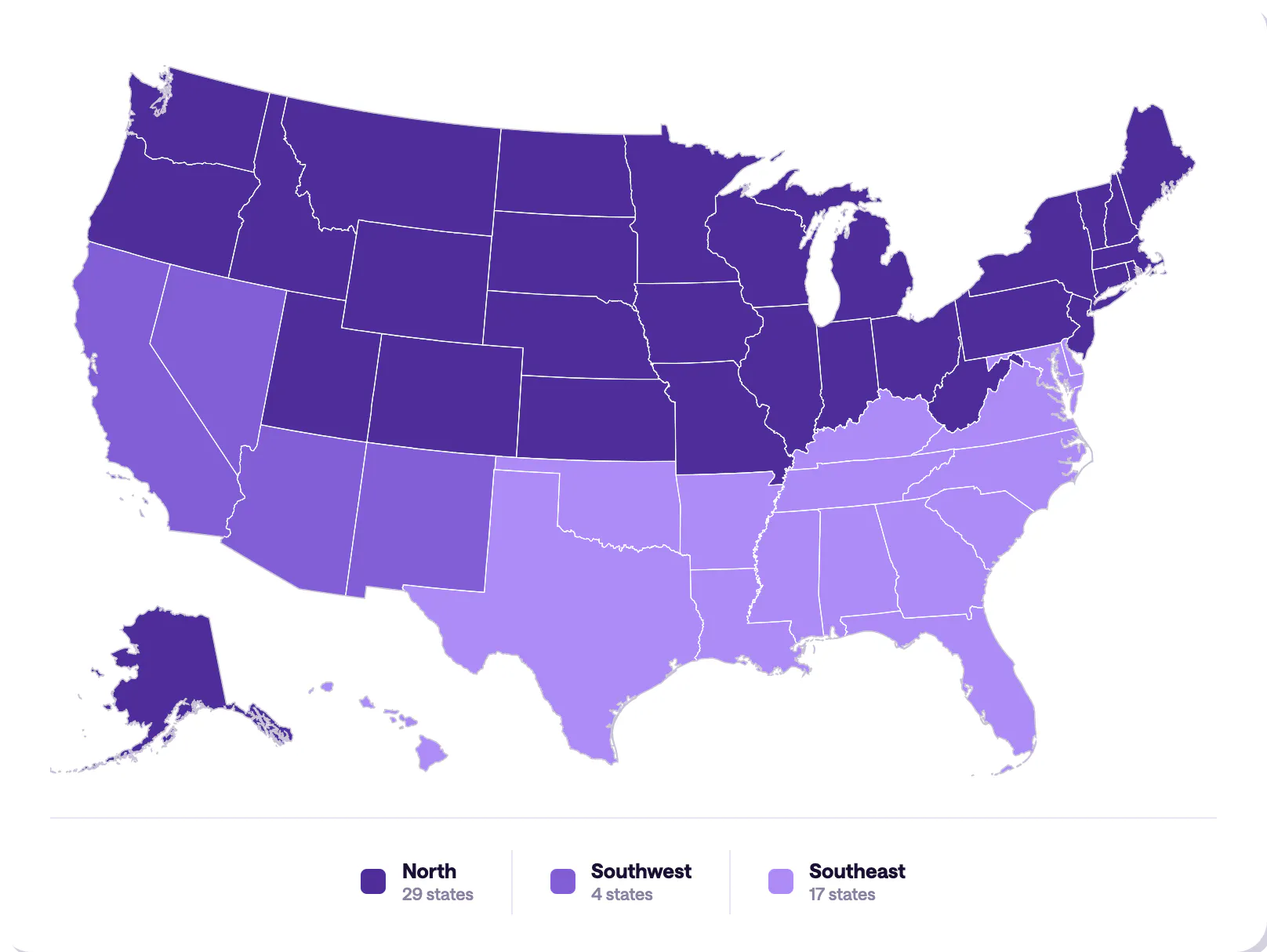
The Department of Energy sets minimum SEER2 requirements by region, because cooling demand varies significantly across the country. Hotter climates have higher minimums.
Minimum SEER2 requirements by DOE region
| Region | States (examples) | Min. SEER2 (split system <45,000 BTU) | Min. SEER2 (split system ≥45,000 BTU) |
|---|---|---|---|
| North | NY, PA, OH, IN, IL, and most northern states | 13.4 | 13.4 |
| Southeast | FL, TX, TN, GA, NC, and most southern states | 14.3 | 13.8 |
| Southwest | CA, NV, AZ, NM | 14.3 | 13.8 |
Source: U.S. Department of Energy via seer2.com
These are just the legal minimums. In hot climates especially, a more efficient system may pay back the price difference in lower energy bills. Exploring your options at a few efficiency levels can be worth it.
Why a professional should size your air conditioner
The industry standard is a detailed analysis that accounts for square footage, ceiling height, insulation, window area and orientation, local climate data, and more, called the Manual J load calculation. The output is a room-by-room cooling load for your home.
Getting one input wrong can push the result meaningfully in either direction.
Here’s what a good process looks like.
- A walkthrough of your home
- Measurements of room dimensions, including ceiling heights
- A conversation about how you use your home: which rooms run hot, whether you work from home, how old the insulation is
- A clear explanation of what's being recommended and why
If a contractor gives you a size without showing their work, ask how they got there.
One more thing worth raising with your contractor: whether a heat pump makes sense. Heat pumps cool the same way central AC does but also provide heat, so they can replace both systems. The sizing process is similar, with extra attention to heating performance at low outdoor temperatures.
Is it time for a new system?
Palmetto's Comfort Plan connects you with qualified HVAC professionals who can assess your home, size the system correctly, and handle installation — with no upfront purchase required. It's an HVAC leasing option that covers equipment, installation, and ongoing service for a predictable monthly payment.
To see how a new air conditioner, heat pump, or other HVAC system works for your home, connect with an HVAC advisor at Palmetto by reaching out for a free quote today.
See how much you can save with a new HVAC system from Palmetto
Frequently asked questions
Is a bigger air conditioner always better?
No. An oversized system short-cycles, or cools quickly, shuts off early, and never runs long enough to dehumidify properly. The result: a clammy room, faster wear and tear, and a shorter system life.
What size air conditioner do I need for a 1,500-square-foot home?
Roughly 24,000–30,000 BTUs, or about 2 to 2.5 tons — but that range can shift based on your climate, insulation, ceiling height, and windows. A Manual J load calculation will get you to a more reliable number than square footage alone.
What size air conditioner do I need for a 2,000-square-foot home?
A starting estimate is 30,000–36,000 BTUs, or about 2.5 to 3 tons. Your actual needs depend on climate, insulation, and other factors. Get a load calculation before committing to a size.
What's the difference between BTU and tons?
Two ways to describe the same thing. One ton equals 12,000 BTUs per hour. A 2.5-ton system and a 30,000 BTU system are identical.
How long does a properly sized central air conditioner last?
A well-sized, well-maintained central air conditioner typically lasts 15 to 20 years. An oversized system that short-cycles will often fail sooner — repeated start-stop cycles wear down the compressor faster than steady operation would.
Disclaimer: This content is for educational purposes only. Palmetto does not provide tax, legal, or accounting advice. Please consult your own tax, legal, and accounting advisors.