Electric Furnace Installation and Cost: What to Expect
Last edited
Author
Andrew Blok
Electrification and Solar Writer and Editor
If you're shopping for a whole-home electric heating system, an electric furnace may be on your list. They're simple to install, don't require a gas line, and can last for decades. But they come with a real trade-off.
Electric furnaces are among the most expensive heating systems to operate month to month.
Before you commit, it's worth understanding what installation involves, what you'll spend upfront, and what you'll spend every winter. If the ongoing energy cost gives you pause, there's another electric option worth knowing about before you decide.
See how much you can save with a new HVAC system from Palmetto
What is an electric furnace?
An electric furnace is a forced-air heating system that uses electric heating elements to warm air and distribute it through your home's ductwork. Unlike a gas furnace, there's no combustion, no flue, and no gas line required.
Electric furnace installation
Installing an electric furnace is less involved than most other whole-home heating systems, but it still requires a licensed HVAC technician and, in many cases, a licensed electrician. Here's how the process typically works.
Site evaluation and system sizing
Before anything is ordered or installed, a technician will assess your home's heating needs by calculating the heating load — how much energy your home needs to stay comfortable on the coldest days of the year. Electric furnace capacity is measured in kilowatts (kW), and the right size depends on your home's square footage, insulation, and climate. An undersized unit will run constantly and struggle; an oversized one will cycle on and off too frequently and wear out faster. Getting the size right is one of the most important things your installer can do.
Electrical inspection and panel work
Electric furnaces require a dedicated 240-volt circuit. If you're replacing an existing electric furnace, that circuit is likely already in place. If not, or if your panel can't support the additional load, an electrician will need to add a circuit or upgrade the panel first — one of the most common sources of added cost in new installs.
Ductwork inspection and preparation
Electric furnaces use standard forced-air ductwork. If your ducts are in good condition, the technician checks for leaks and confirms proper airflow sizing. Any needed duct sealing, repairs, or extensions happen before the new unit goes in.
Furnace installation and connection
The new unit is set in place, connected to your ductwork, and wired to its dedicated circuit. The technician installs disconnect switches, confirms proper grounding, and removes any old system.
Testing and commissioning
Once everything is connected, the technician powers the system up, checks airflow through each register, confirms the heating elements are cycling correctly, and verifies the thermostat is communicating with the furnace before wrapping up.
See how much you can save with a new HVAC system from Palmetto
Electric furnace installation cost
Electric furnace installation is more affordable upfront than most other whole-home heating systems. According to a survey of online consumer sources, total installed cost typically ranges from about $2,500 to $7,500, with most projects landing between $4,000 and $6,000.
Here's what drives that number:
The furnace unit itself generally runs $800 to $2,500, though larger or higher-output models cost more.
Labor typically adds $800 to $2,500 depending on job complexity, local rates, and install time. Replacements take considerably less time than new installations.
Electrical work, if needed, can add $500 to $2,000. If your panel needs an upgrade or a new dedicated circuit, budget for that separately.
Ductwork repairs or additions vary widely. Minor sealing and cleaning might run a few hundred dollars. Adding new duct runs can cost $1,000 to $3,000 or more.
Permits and inspection fees typically run $100 to $500 depending on your municipality.
Replacement installs with existing wiring and ducts land at the lower end; new installs with panel work push toward the top or beyond.
| Element | Cost range | Notes |
|---|---|---|
| Equipment (furnace) | $800-$2,500 | Depends on size, brand, quality, and supply. |
| Labor | $800-$2,500 | Depends on local labor rate, extra work required, size of furnace and house. |
| Electrical work | $500-$2,000 | Extra is electrical panel needs an upgrade. |
| Ductwork repairs | $500-$2,000 | Not necessary when ducts are in good repair. Depends on extent of repairs needed. |
| Permits and inspections | $100-$500 | Depends on fees charged by local municipality or permitting authority. |
Electric furnace operating cost
Installation cost is only part of the picture. For electric furnaces, operating cost is where the real conversation begins.
What you'll spend each month
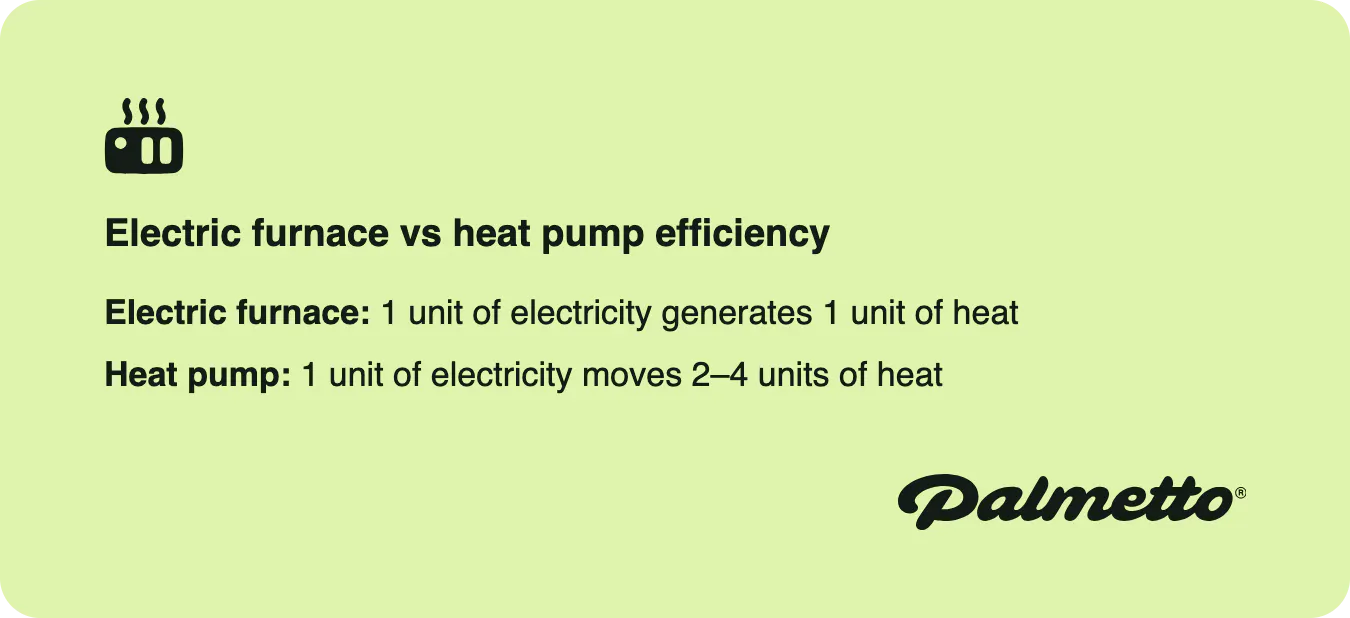
Electric furnaces convert electricity to heat at essentially 100% efficiency — every unit of electricity in becomes a unit of heat out. That sounds good on paper, but it means you're buying all of your heat at retail electricity prices. That can get expensive, especially compared to more efficient electric options.
The US Department of Energy found, for example, that “in Michigan, for homes that are currently heating with propane or electricity,” an electric cold-climate heat pump could save households $1,500 annually on average.
Your actual costs depend on home size, insulation, climate, local electricity rates, and thermostat habits.
Why electric furnace operating costs are relatively high
The issue isn't efficiency in the traditional sense — it's the cost of the fuel itself. Electricity is generally more expensive per unit of heat delivered than natural gas, and an electric furnace operates at a strict one-to-one ratio: one unit of electricity in, one unit of heat out.
A heat pump works differently. Instead of generating heat, it moves heat from outdoor air into your home, delivering two to four units of heating energy per unit of electricity consumed. According to a survey of online consumer sources, running an electric heat pump during heating season typically costs $40 to $160 per month — compared to $130 to $180 for an electric furnace. That gap compounds over a heating season and over the life of the system.
Electric furnaces make the most sense in milder climates, in homes where a heat pump isn't feasible, or where the lower upfront cost is the deciding factor.
A note on lifespan
Electric furnaces tend to last 20 to 30 years — longer than most gas furnaces. That's a genuine durability advantage, but it also means you'll be paying monthly operating costs for a long time. Worth factoring in.
Leasing your HVAC system
When you lease an HVAC system, like with the Palmetto Comfort Plan, you swap the high upfront cost of purchasing and installing the equipment for predictable monthly payments for the length of your lease term. Those payments typically cover regularly scheduled maintenance and common repairs.
If you want to understand how the math works for your home, see the HVAC options available through Palmetto.
See how much you can save with a new HVAC system from Palmetto
Frequently asked questions
How long does it take to install an electric furnace? A replacement on an existing system typically takes three to five hours. A new installation without an existing dedicated circuit or ductwork can take a full day or more.
Do I need both an HVAC technician and an electrician? It depends on the scope of work. A straightforward replacement with no electrical changes typically needs only a licensed HVAC technician. If new circuits or panel upgrades are required, a licensed electrician will need to be involved as well.
Can an electric furnace work with any ductwork? In most cases, yes. Electric furnaces use standard forced-air ductwork, so existing ducts will usually work. The technician should inspect them before installation. Homes without ductwork would need it added, which significantly increases project cost.
How long does an electric furnace last? Typically 20 to 30 years with regular maintenance — longer than most gas furnaces, which average 15 to 20 years. Annual checkups and regular filter changes are the biggest factors in reaching the high end of that range.
Disclaimer: This content is for educational purposes only. Palmetto does not provide tax, legal, or accounting advice. Please consult your own tax, legal, and accounting advisors.