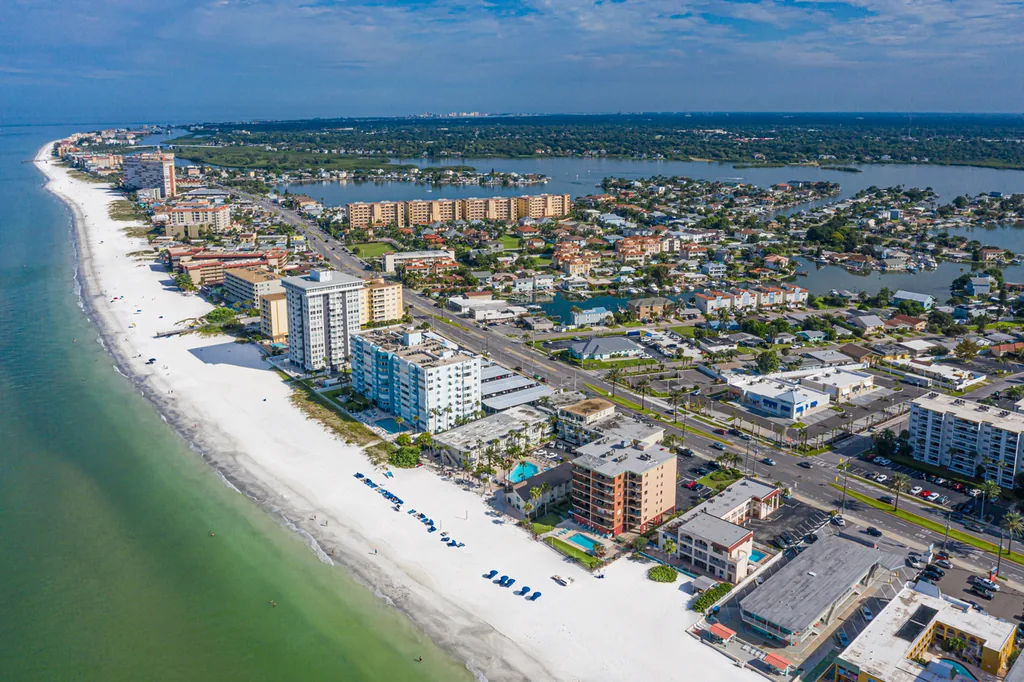
St. Petersburg, FL Solar Panels
In This Guide
- 01 Solar Energy in St. Petersburg
- 02 Solar Cost Calculator
- 03 St. Petersburg Reviews
- 04 Key Takeaways
- 05 St. Petersburg Electricity Prices
- 06 Florida Solar Incentives
- 07 St. Petersburg Solar Production
- 08 Solar Installations in St. Petersburg
- 09 Choosing an Installer
- 10 Leasing Solar Panels
- 11 Frequently Asked Questions

Solar Power in St. Petersburg
For homeowners in St. Petersburg, Florida, solar installation starts with the details of the home: roof condition and direction, tree shade, electricity use, and utility plan all shape whether panels may be a good fit. Florida ranks second in the nation for residential solar installations.
Explore how system design and installation work, along with the questions to ask along the way. Our guide to home solar panels is a helpful place to start.
How Much Do Solar Panels Cost in St. Petersburg, FL?
Explore estimated solar installation costs in St. Petersburg using Palmetto’s firsthand data from completed installations across the area, including nearby communities like Gulfport, Pinellas Park, and Kenneth City. See how local project costs can help you understand what solar may cost for your home.
System
- No upfront investment
- Palmetto handles all maintenance
- 90% Production Guarantee
- Comprehensive protection program included
Key Takeaways
- Solar suitability depends on your home—roof condition, direction, shade, electricity use, and utility plan all shape system design in St. Petersburg.
- St. Petersburg’s sunshine supports solar, but clouds and seasonal daylight affect production; a 10-kW system estimate is about 16,009 kWh per year.
- Compare costs, lease terms, and Florida tax benefits—estimates vary by home, and utility rules and eligibility affect your results.
St. Petersburg Electricity Prices
For St. Petersburg homeowners, electricity costs matter—not just today, but over the years a home uses power.
The chart shows statewide Florida residential rates, not St. Petersburg utility prices: they rose from 11.9¢/kWh in 2021 to 15.2¢ in 2023, then eased to 14.1¢ in 2024. The national average reached 16.5¢ in 2024.
A solar system can generate power at home and reduce how much electricity a household buys from its utility. The effect depends on system design, household use, roof condition and shade, and utility billing rules.
Over time, producing some of your own electricity may help limit exposure to changing utility rates. Actual bill impacts vary, so homeowners should consider upfront costs, expected production, maintenance, and utility rules when weighing solar’s long-term value.
Price of Energy: Florida vs National Average
St. Petersburg Area Utility Providers
St. Petersburg homes may receive electricity from Duke Energy Florida or Tampa Electric (TECO). The latest figures provided are from 2023; 2024 utility data is not yet available.
In 2023, Duke Energy Florida averaged 18.1¢ per kWh and TECO averaged 16.6¢. Both were above Florida’s 15.20¢ average; Duke was also above the 16.0¢ national average, while TECO was slightly higher.
Solar panels can generate some of a home’s electricity, which may reduce how much power it needs to buy from the utility. How much that changes a bill depends on the home’s energy use and solar system.
St. Petersburg Utilities Electricity Rates
Florida Solar Incentives
St. Petersburg homeowners can explore Florida tax incentives and utility financing options, though eligibility varies; see the table of solar incentives in Florida.
Florida exempts qualifying solar and storage equipment from sales tax and provides property-tax relief for eligible renewable-energy devices. Lakeland Electric and Florida Keys Electric Cooperative financing is limited to their customers or members and may not apply in St. Petersburg.
Federal 30% residential tax credit ended under the Big Beautiful Bill, but state incentives remain. With LightReach leasing, Palmetto handles the commercial ITC and passes savings through as lower payments.
| Incentive | Type | Description | Source |
|---|---|---|---|
| Florida Solar and Energy-Storage Equipment Sales Tax Exemption | Sales Tax Exemption | Florida exempts qualifying solar-energy system components, including eligible photovoltaic and energy-storage equipment, from state sales and use tax. | Learn More |
| Florida Residential Renewable-Energy Property Assessment Exclusion | Property Tax Assessment Exclusion | For qualifying residential property, Florida excludes the just value attributable to qualifying renewable-energy devices, including eligible solar and storage equipment, from the property assessment. | Learn More |
| Florida Renewable-Energy Device Tangible Personal Property Tax Exemption | Property Tax Exemption | Florida exempts 80% of the assessed value of qualifying renewable-energy devices that are treated as tangible personal property from ad valorem taxation. | Learn More |
Florida exempts qualifying solar-energy system equipment from sales and use tax, reducing the upfront purchase cost by the tax that otherwise would apply. Eligible components identified by the Florida Department of Revenue include photovoltaic and power-conditioning equipment, solar collectors, and qualifying energy-storage units and integral accessories.
The exemption is for qualifying equipment, not automatically for every product or charge included in an installation. The purchaser certifies eligibility to the seller, and equipment must meet the state’s applicable requirements. Ask the installer to identify eligible items separately and confirm how the exemption is applied to your purchase. Florida Statute §212.08 and Florida Department of Revenue guidance.
Florida excludes the portion of a residence’s just value attributable to a qualifying renewable-energy device from the property-tax assessment. This can reduce the assessed value used to calculate property taxes after installing eligible solar equipment or qualifying energy-storage equipment; it is not a rebate or a dollar-for-dollar tax credit.
The residential provision covers qualifying devices installed on or after January 1, 2013, and the current statute provides for the exclusion through December 31, 2037. The amount of any tax savings depends on the value attributed to the equipment and local tax rates. Contact your county property appraiser about documentation and how the provision applies to your system. See Florida Statute §193.624.
Florida exempts 80% of the assessed value of a qualifying renewable-energy device from ad valorem taxation when the device is tangible personal property. For an eligible solar installation, this may reduce the taxable value attributable to qualifying equipment; the actual savings depend on the assessment and local tax rates.
The provision generally applies to qualifying devices installed on real property on or after January 1, 2018, and is distinct from the real-property assessment treatment under §193.624. It is not a cash payment, and it applies only where the equipment qualifies as tangible personal property. Ask your county property appraiser whether your system qualifies and what filing or records are required. See Florida Statute §196.182.
Ready to start saving with solar?
Speak with a Palmetto solar expert to find out exactly how much you can save with Florida incentives.
Get a Free QuoteSt. Petersburg Solar Irradiance
Solar panel production varies throughout the year based on daylight hours, weather patterns, and sun intensity. Understanding how seasons affect your solar system helps set realistic expectations for your investment.
St. Petersburg’s abundant sunshine supports solar, though summer thunderstorms and seasonal changes in daylight affect monthly output. With a well-designed system, cloudy-weather concerns needn’t rule out solar.
Solar Production in St. Petersburg by Month
What Can Your Solar System Power?
Summer Production (July)
In July, your 10 kW system could power:
- 3.6 average homes (15 kWh/day per home)
- or Run central AC for 18 hours AND power all other appliances
- or Fully charge 5.4 Tesla Model 3 electric vehicles
Winter Production (December)
In December, your 10 kW system could power:
- 2 average homes (15 kWh/day per home)
- or Keep your home heating system running for 15 hours
- or Fully charge 3 Tesla Model 3 electric vehicles
Annual Production
Over a year, your 10 kW system could:
- Offset 10 tons of carbon dioxide emissions
- or Equal the environmental benefit of planting 175 trees
- or Save approximately $4,234 in electricity costs
Want to know exactly how much solar can power your home?
Get a personalized solar analysis based on your actual home, energy usage, and roof characteristics.
Get My Custom EstimateSolar Panel Systems in St. Petersburg
We’ve organized solar installation data from across the country to create this interactive map of St. Petersburg. Explore the hexagons to see how many homes in each area have gone solar, and discover the neighborhoods and communities whose residents have made the switch.
How to Choose a Solar Installer in St. Petersburg
Verify the license
Ask which Florida contractor credential covers the installation and request the credential details before signing. The Florida Department of Business and Professional Regulation’s Construction Industry Licensing Board lists Certified Solar Contractor (CV) and Registered Solar Contractor (RV) classifications. A CV credential allows statewide contracting; an RV credential is limited to its authorized jurisdiction. A separate solar credential is not always required: another Chapter 489 certified or registered contractor may perform solar work within the contractor’s authorized scope. Confirm the credential with the state and your city or county, and check that the contractor’s authorization covers your project. See Florida’s contractor licensing statute.
Look for certified installers
Ask whether the people designing and installing your system hold NABCEP certifications, and what each certification covers. NABCEP provides information about its certifications. Also ask about manufacturer certifications for the proposed panels and inverters; their scope can vary, so find out which products and work they cover. These credentials can help you assess relevant training, but they do not replace the Florida contractor credential. Ask for current details rather than relying on a logo in a proposal.
Compare quotes the same way
Request written proposals with the same categories so you can compare the systems and the payment terms—not just the headline price. Check:
- System size in kW and price per watt, using a consistent price basis.
- Panel and inverter brands and models.
- Estimated production in kWh per year, plus the assumptions behind the estimate.
- Warranty terms for panel product and performance, inverter, workmanship, and roof penetrations.
- Who handles building and electrical permits and the utility interconnection application.
- Total cost or monthly payment, what that payment includes, and any escalator.
Compare ownership and payment options on the same basis. For context only, Palmetto reports a median installed system size of 10.6 kW and about 54 days from signing to installation; those company figures are not a forecast or promise for your project.
Permits, interconnection and your HOA
Building and electrical permits go through the local enforcement agency—typically the city or county building department for the property. Ask who will prepare and submit them. For interconnection approval and any required agreement or metering, the homeowner applies to the electric utility serving the property; ask whether the installer will assist. Utilities in the area include Florida Power & Light Co, Duke Energy Florida, LLC, Tampa Electric Co, and JEA, but confirm which serves your address and check its program. Florida Statute § 163.04 bars binding agreements from prohibiting or effectively prohibiting solar collectors. An association may specify a roof location within the statute’s south-facing orientation if that does not impair effective operation.
Red flags
- Pressure to sign the same day, before you can review the proposal and contract.
- Crews whose Florida credential or responsible licensed contractor you cannot verify, including out-of-state crews that cannot explain who holds it.
- Vague production estimates, or refusal to explain the estimate’s assumptions.
- A large upfront deposit without clear written terms for what it covers and when it is due.
- Promises of federal homeowner tax credits for 2026 purchases; homeowner credits ended December 31, 2025.
Palmetto is one installer you can include in your comparison, with a lease option available through LightReach.
Leasing Solar Panels
For eligible St. Petersburg homes served by Tampa Electric (TECO) or Duke Energy Florida, Palmetto offers a solar lease through LightReach. A lease typically has a set monthly payment; a power purchase agreement (PPA), by contrast, charges for each kilowatt-hour the system produces. See how buying and leasing solar compare.
Leasing can reduce the upfront expense compared with paying cash for a system. With a cash purchase, you own the equipment and are generally responsible for arranging maintenance and repairs. Under the LightReach lease, Palmetto owns the system and handles maintenance under the agreement, so homeowners have fewer system-care responsibilities.
Lease terms and eligibility vary, and utility service area matters. Learn more about LightReach solar leasing and review your agreement for payment, maintenance, and service details.
Go solar without the investment
With LightReach, there are no investment costs to recoup, loan payments to manage, or maintenance needs to take on. As soon as your panels are active, your solar savings are too!
Explore LightReach LeasingFrequently Asked Questions
Yes. St. Petersburg homeowners served by Tampa Electric (TECO) or Duke Energy Florida generally have 1:1 net metering. Solar electricity sent to the grid earns kWh credits that can carry over from month to month.
At the December annual true-up, remaining credits are paid at an avoided-cost rate—about $0.02/kWh for TECO and roughly $0.02–$0.03/kWh for Duke Energy—then the credit balance resets. Check your electric bill to confirm your utility and its current rules.
Solar panels may increase a St. Petersburg home’s resale value when the system is purchased and owned. A Zillow study found homes with solar panels sold for approximately 4.1% more, though this national finding does not guarantee a higher sale price for every home.
This estimate applies to owned systems, not leased or third-party-owned (TPO) systems. With a lease, a buyer may need to assume the agreement, which can affect resale differently. Roof condition, system age, energy savings, and buyer demand also matter.
In St. Petersburg, homeowners can go solar with a LightReach lease for a low fixed monthly payment and no upfront cost. The calculator above estimates $135 per month for a typical 2,000–3,000-square-foot home; actual payments depend on home size and system design.
A cash purchase is another option: the estimate is $28,316 for a 10.53-kW system. The federal 30% tax credit is no longer available for residential cash purchases following the 2025 federal law change. See the calculator above for small- and large-home estimates.
In St. Petersburg, a typical 10.53 kW solar lease through Palmetto’s LightReach is about $135 per month, with no upfront cost. The estimate uses Florida’s production ratio of 1,462 kWh per kW annually and a $0.105/kWh rate; actual payments depend on system design and lease terms.
One payment covers panels, installation, monitoring, maintenance, and protection, including a 90% production guarantee. Palmetto owns the system, claims the commercial 30% ITC, and passes savings through as lower payments. Because the lease payment is typically less than the current electricity bill, savings can begin from day one.
Solar panels are low maintenance for St. Petersburg homeowners. Rain often rinses off light dust, but it’s sensible to check system output and have panels inspected if you notice a drop in production or visible damage.
With a LightReach lease, Palmetto owns the system and handles maintenance, monitoring, and repairs at no extra cost, including a 90% Production Guarantee.
A typical 10-kW solar system in St. Petersburg is estimated to produce about 16,000 kWh per year, or roughly 44 kWh per day on average, based on the article’s NREL PVWatts production estimate.
Actual output varies with roof direction and condition, shade from trees or nearby buildings, weather, and season. St. Petersburg systems generally produce less on cloudy days and as daylight hours change through the year.
There isn’t one best solar installer for every St. Petersburg home. Roof condition, shade, electricity use, utility rules, system design, total cost, and service terms all affect which installer is the right fit.
Palmetto Solar is a national company with a local focus and installation network; we’ve completed 22,293 installations in Florida since 2020. We offer financing options, and homeowners can compare those terms with cash purchase or lease costs before deciding.
Explore Solar Power in Other Florida Cities
- Solar in Boca Raton
- Solar in Bradenton
- Solar in Cape Coral
- Clermont Solar Panels
- Davenport Solar Panels
- Fort Myers Solar Installation
- Solar in Kissimmee
- Naples Solar Panels
- Ocala Solar Panels
- Orlando Solar Panels
- Palm Bay Solar Panels
- Port Charlotte
- Port St. Lucie Solar Panels
- Punta Gorda
- Riverview Solar Panels
- Sarasota Solar Panels
- Tampa Solar Panels
- The Villages Solar Installation
- Venice Solar Panels
- Winter Garden, FL